


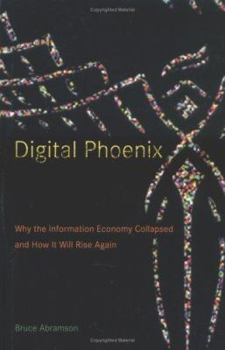
Digital Phoenix: Why The Information Economy Collapsed And How It Will Rise Again

Select Format
Select Condition 
Book Overview
While we were waiting for the Internet to make us rich - back when we thought that all we had to do was to buy lottery tickets called dotcom shares - we missed the real story of the information economy. That story, says Bruce Abramson in Digital Phoenix, took place at the intersection of technology, law and economics. It unfolded through Microsoft's manipulation of software markets, through open source projects like Linux, and through the file-sharing adventures that Napster enabled. Linux and Napster in particular exploited newly enabled business models to make information sharing cheap and easy; both systems met strong opposition from entrenched interests intent on preserving their own profits. These scenarios set the stage for the future of the information economy, a future in which each new technology will threaten powerful incumbents - who will, in turn, fight to retard this dangerous new direction of progress. Disentangling the technological, legal, and economic threads of the story, Abramson argues that the key to the entire information economy - understanding the past and preparing for the future - lies in our approach to intellectual property and idea markets. creation and dissemination of ideas. After discussing relevant issues in intellectual property and antitrust law, the economics of competition, and artificial intelligence and software engineering, Abramson tells the information economy's formative histories: the Microsoft antitrust trial, the open-source movement, and (in a chapter called The Computer Ate My Industry) the advent of digital music. Finally, he looks toward the future, examining some ways that intellectual property reform could power economic growth and showing how the information economy will reshape the ways we think about business, employment, society, and public policy - how the information economy, in fact, can make us all rich, as consumers and producers, if not as investors.
Format:Hardcover
Language:English
ISBN:0262012170
ISBN13:9780262012171
Release Date:January 2005
Publisher:Mit Pr
Length:361 Pages
Weight:1.94 lbs.
Dimensions:9.8" x 1.3" x 6.3"
Customer Reviews
3 ratings
A Crash Course in the Information Age
Published by Thriftbooks.com User , 20 years ago
Abramson is the ultimate story teller. This collection of essays provides a multi-disciplinary foundation to understanding how we became global citizens of the Information Age. Whether your interest lies in law, economics, politics or computer science, you will find the time invested in the book very worthwhile. Read it once for an overview; read it again to become truly knowledgeable. Keep it at hand as a reference.
Essential reading for anyone in the Information Economy
Published by Thriftbooks.com User , 20 years ago
Finally, a book that explains what happened and where we're going. Abramson provides a lucid framework for understanding the dynamics of the information economy--a virtual theory of everything. Innovation isn't enough; bubble's are normal; a regulatory and legal framework is necessary for consistent advancement; most important, the choices we make now as a society will affect the direction and growth of the information economy. Read this book--then everything else you read about about the technology, law and economics of the information economy will make sense.
Great storytelling
Published by Thriftbooks.com User , 20 years ago
Don't be scared...this is MIT press, but popular writing. Abramson nails it: why it happened, what's apt to happen in the future. But most of all, this is a great read--the stories are told with such panache that you hardly realize that you are tackling cutting edge issues in law, economics and, yes, politics. Worthy of reading twice: once for the stories, once for the underlying arguments.
Copyright © 2026 Thriftbooks.com Terms of Use
| Privacy Policy | Do Not
Sell/Share My Personal Information | Cookie Policy | Cookie Preferences | Accessibility Statement
ThriftBooks® and the ThriftBooks® logo are registered trademarks of Thrift Books Global, LLC
ThriftBooks® and the ThriftBooks® logo are registered trademarks of Thrift Books Global, LLC
