


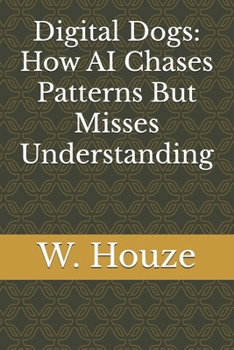
Digital Dogs: How AI Chases Patterns But Misses Understanding
No Customer Reviews

"Digital Dogs: How AI Chases Patterns But Misses Understanding" examines the fundamental limitations of artificial intelligence through empirical testing and theoretical analysis. Drawing from extensive experiments with leading AI models including GPT-4, Claude, and Gemini, the book demonstrates how current AI systems excel at pattern recognition while consistently failing to achieve true understanding or meta-analysis. The investigation begins with a novel experimental framework testing AI models' ability to extract meaning from both structured and unstructured data. Through carefully designed tests using random data tables, Wikipedia articles, and technical documentation, the author reveals how AI responses remain trapped in pattern-matching behavior even when explicitly prompted to perform deeper analysis. Central to the book's argument is the distinction between Pattern Analysis (PA) and Meta-Analysis (M-A). While AI systems demonstrate remarkable capabilities in identifying and reproducing patterns, they consistently fall short of genuine meta-analytical understanding. This limitation manifests across multiple domains, from basic text analysis to complex reasoning tasks. The book introduces the concept of the "Brain-Machine Barrier" - a fundamental constraint that prevents current AI systems from bridging the gap between pattern recognition and true comprehension. This barrier is explored through extensive testing of different AI models' capabilities, revealing how even the most advanced systems remain bounded by their programming constraints. Historical parallels are drawn to previous technological movements, including the Railroad Mania of the 1840s, the Phrenology Movement, and Medieval Alchemical Societies. These analogies illuminate recurring patterns in how transformative technologies are oversold and misunderstood by both practitioners and the public. A significant portion of the book is dedicated to analyzing the performance differences between various AI models, with particular attention paid to Claude Pro's unique capabilities in displaying limited meta-analytical abilities. This analysis provides insight into both the current state of AI technology and its potential future development paths. The author examines implications for the AI industry, exploring how the emphasis on pattern analysis over true understanding affects everything from system design to ethical considerations. Special attention is given to the role of cognitive abilities in AI development, challenging common assumptions about intelligence requirements in the field. The book concludes with a critical examination of the gap between AI's marketed capabilities and its actual limitations, proposing a framework for more realistic assessment and development of AI systems. It argues for a balanced approach that acknowledges both the remarkable achievements in pattern recognition and the persistent limitations in achieving genuine understanding.
Format:Paperback
Language:English
ISBN:B0DW46SX7S
ISBN13:9798309460427
Release Date:February 2025
Publisher:Independently Published
Length:380 Pages
Weight:1.12 lbs.
Dimensions:0.8" x 6.0" x 9.0"
Customer Reviews
0 rating
Copyright © 2026 Thriftbooks.com
Terms of Use | Privacy Policy | Do Not Sell/Share My Personal Information | Cookie Policy | Cookie Preferences | Accessibility Statement
ThriftBooks ® and the ThriftBooks ® logo are registered trademarks of Thrift Books Global, LLC
ThriftBooks ® and the ThriftBooks ® logo are registered trademarks of Thrift Books Global, LLC
