


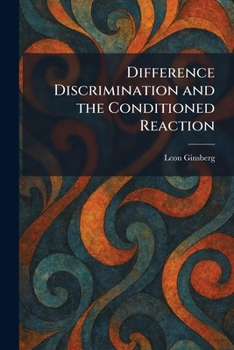
Difference Discrimination and the Conditioned Reaction

"Difference Discrimination and the Conditioned Reaction" is a rigorous psychological investigation into the mechanisms of sensory perception and behavioral learning. Written during the formative years of experimental psychology, this work by Leon Ginsberg explores how organisms differentiate between varying stimuli and the resulting development of conditioned responses. The text examines the physiological and cognitive thresholds of discrimination, providing a detailed look at the precision with which reflexes are formed and modified based on environmental cues.
As a significant contribution to the field of behaviorism, the work delves into the principles of stimulus generalization and the specific conditions required for accurate differentiation in a laboratory setting. Ginsberg's analysis offers valuable insights into the foundations of learning theory, bridging the gap between basic sensory input and complex behavioral output. This treatise is an essential resource for scholars of the history of psychology and researchers interested in the evolution of cognitive science and experimental methodology. Through its systematic approach to the conditioned reaction, "Difference Discrimination and the Conditioned Reaction" remains a foundational text for understanding the early scientific approach to human and animal behavior.
This work has been selected by scholars as being culturally important, and is part of the knowledge base of civilization as we know it. This work was reproduced from the original artifact, and remains as true to the original work as possible. Therefore, you may see the original copyright references, library stamps (as most of these works have been housed in our most important libraries around the world), and other notations in the work.
This work is in the public domain in the United States of America, and possibly other nations. Within the United States, you may freely copy and distribute this work, as no entity (individual or corporate) has a copyright on the body of the work.
As a reproduction of a historical artifact, this work may contain missing or blurred pages, poor pictures, errant marks, etc. Scholars believe, and we concur, that this work is important enough to be preserved, reproduced, and made generally available to the public. We appreciate your support of the preservation process, and thank you for being an important part of keeping this knowledge alive and relevant.
Related Subjects
PsychologyCustomer Reviews
ThriftBooks ® and the ThriftBooks ® logo are registered trademarks of Thrift Books Global, LLC
