


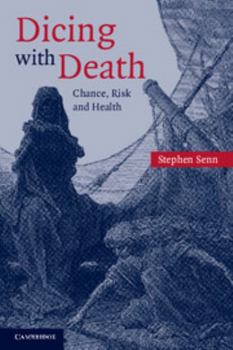
Dicing with Death: Chance, Risk and Health


Select Format
Select Condition 
Book Overview
If you think that statistics has nothing to say about what you do or how you could do it better, then you are either wrong or in need of a more interesting job. Stephen Senn explains here how statistics determines many decisions about medical care, from allocating resources for health, to determining which drugs to license, to cause-and-effect in relation to disease. He tackles big themes: clinical trials and the development of medicines, life tables, vaccines and their risks or lack of them, smoking and lung cancer and even the power of prayer. He entertains with puzzles and paradoxes and covers the lives of famous statistical pioneers. By the end of the book the reader will see how reasoning with probability is essential to making rational decisions in medicine, and how and when it can guide us when faced with choices that impact on our health and even life.
Format:Paperback
Language:English
ISBN:0521540232
ISBN13:9780521540230
Release Date:November 2003
Publisher:Cambridge University Press
Length:264 Pages
Weight:0.96 lbs.
Dimensions:0.7" x 6.1" x 9.2"
Customer Reviews
2 ratings
Best account of how statisticians view the world.
Published by Thriftbooks.com User , 18 years ago
Excellent! The focus is on statistics in medicine, but the book zigzags through recent issues (ethics and politics of clinical trials, lawyer's abuse of statistical evidence, vaccine scares), sometimes sophisticated analysis of particular data, combined with explanation and history of basic concepts, with half-page biographies of historical and modern statisticians going far beyond the usual suspects. Has the lively style of The Economist, addressing a mentally alert adult reader rather than a casual reader or bored student. In particular, readers who have taken one course in statistics will get a view of "the big picture", and this is the best single book for that purpose.
Excellent guide to medical statistics
Published by Thriftbooks.com User , 19 years ago
Senn provides a broad introduction to key statistical ideas relevant to medicine and epidemiology. He switches effortlessly between basic concepts such as hypothesis testing, standard error and conditional probabilities to deep philosophy such as Bayesian versus frequentist schools, irrationality of induction and the use of meta-analysis. His style is highly readable mixing technical content with historical anecdotes and startling digressions. The ideal reader is someone who has a decent background in statistics, such as that gained in a university-level statistics course. The key strengths of the book include: (1) clear, lucid explanation of many concepts including modern ones not typically covered in first courses -- for instance, the contrast between Bayesian and frequentist approaches is done much better here than in most other books; (2) about 1/2-1/3 of the examples come from the real world (the remainder split between coin tossing experiments and hypotheticals), which is a high proportion among this sort of books; (3) good discussion of intuition and reasoning as opposed to just formulae. The weaknesses (quibbles) include: (1) Senn's penchant for puns and word play provides humor but can get in the way of understanding the material; (2) his frequent digressions leave a host of loose ends and dead ends, which can frustrate some readers but for others, this strategy reveals exciting avenues for further exploration. This is really a great book for someone who knows some statistics and really want to dig much deeper into the intuition and philosophy behind this field.
Copyright © 2026 Thriftbooks.com Terms of Use
| Privacy Policy | Do Not
Sell/Share My Personal Information | Cookie Policy | Cookie Preferences | Accessibility Statement
ThriftBooks® and the ThriftBooks® logo are registered trademarks of Thrift Books Global, LLC
ThriftBooks® and the ThriftBooks® logo are registered trademarks of Thrift Books Global, LLC
