


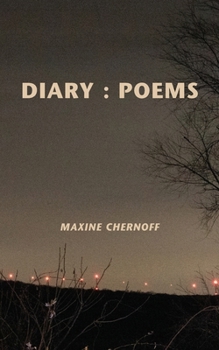
Diary: Poems

Diary: Poems reflects the world, with personal experience written in the margins and the story of our moment filling the space of the prose poems. From war to global warming to homelessness to the difficulties experiencing safety and connection under such conditions, these situations lead to moments of attention to the state of the world, written with "you" or "we" speakers to emphasize the collective nature of our experience, and highlight the universal, broken into moments of observation or imagined scenes. Sometimes the personal breaks
through, always with the traditional "I," whose experience is minimized by the weight of the larger situation.
Since the poems pay great attention to the moment - to presence - they are laden with visual and imagistic content: from a mother and child sitting in the rubble of Gaza to a couple in Ukraine disappearing into the woods to escape harm to an immigrant family crossing our border and sharing imaginary nourishment, we encounter portraits of our current state of affairs. Also appearing are works of commentary and many poems examining the thin veil between life and death: can it be crossed by imaginative effort?
The world as cauldron is burning with stories and reasons to speak. Diary: Poems exists as a document of what is seen and said. As such, it enlarges on the traditional sense of the genre, traditionally self-absorbed and narrow, and offers a contemporary version of what it means to live and write at the boundary of peril to the whole, how one small voice can partake in the mood of our time and account for what it observes, as all significant narrative opens rather than limits possibility. Diary: Poems is an awakening of language, inviting the reader to take responsibility for a world shaped by our difficult and challenging times. Chernoff 's poems keep our minds open and our eyes on what is truly necessary
Related Subjects
PoetryCustomer Reviews
ThriftBooks® and the ThriftBooks® logo are registered trademarks of Thrift Books Global, LLC
