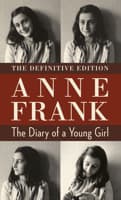
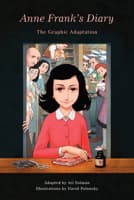
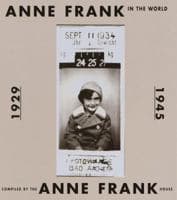
Few more poignant true stories emerged from World War II than the diary of young Anne Frank. Adapted by Albert Hackett and Frances Goodrich, this eternally moving production shows in harrowing detail the twenty-five months that two Jewish families spent hiding from the Gestapo in an Amsterdam warehouse. During the Nazi occupation of the Netherlands, Anne Frank began to keep a diary on June 14, 1942, two days after her 13th birthday and twenty-two days before going into hiding with her parents, sister and three other people. Hiding in the sealed-off upper rooms of the annex of her father's office building in Amsterdam, Anne and the others cope with the day-to-day struggles of life in cramped quarters, as the specter of tragedy looms ever-present over their every move. This description may be from another edition of this product.
Born in 1929 in Frankfurt, Germany, Annelies Marie "Anne" Frank moved with her family to Amsterdam in 1933 to escape German persecution of Jews.The Germans took over the Netherlands in 1940, and the Frank family, like other Jews, was trapped in Amsterdam. The Franks and several other families went into hiding, helped by a small group of heroic helpers who helped sustain the fugitives. Anne received a diary for her thirteenth birthday, and it was just a few weeks later when they fled to the Secret Annex. During their two years of concealment, Anne Frank wrote daily in her diary, creating a remarkable record of her experiences, hopes, and dreams. In 1944, Nazis stormed the attic hideaway, arresting all the occupants and transporting them to concentration camp. Frank died of typhus in Bergen-Belsen in 1945. Her diary, found and saved by trusted family protector Miep Gies, was returned to Otto Frank, Anne's father and the only surviving member of her family. Published in English as Anne Frank: The Diary of a Young Girl, the book has been published in sixty-seven languages. It continues to be one of the most widely read firsthand accounts of the Holocaust, and was adapted into a Pulitzer-Prize winning play and later a film.
I was expecting the novel "Diary of Anne Frank" - this is a screenplay and has very little to do with the book I was expecting. The image is small enough I could not tell this was just a screenplay. Disappointed.
2
★★★☆☆
Play
By mari, May 28, 2020
Verified Purchase
the book is a play and not a story
2
★★★★★
Simply must be read.
By Thriftbooks.com User, February 15, 2005
If ever there was a text that should not only be read but read and re-read, then this insightful and intensely private collection is it. One cannot stress enough how important the work is, not only in terms of it's strong statement agaisnt racism and facism, but also in terms of it's fragile beauty. The tragedy of the novel is in it's exposed privacy, the emerging spirit of a developing and intelligent young woman and the sense it gives us of a thousand similair stories never told and lost forever.
3
★★★★★
A classic work
By Thriftbooks.com User, October 21, 2001
I have read this book many times, and each time I do so, I am struck that Anne began writing this when she was only 13-years-old. It is as fresh today as it was when I read it the first time about 30 years ago.I am always struck by those who use Anne's quote about people really being good at heart. . . According to Anne's friend, Lies Gosslar, Anne certainly didn't think people were good at heart after being imprisoned at Aushwitz and Bergen-Belsen. Trying to put a happy face on the Holocaust or give it a positive spin is really more than I can stomach.
1
★★★★★
sad but uplifting
By Thriftbooks.com User, December 21, 1999
This is one of the most depressing and yet uplifting stories of all time. I just finished a production of the play and I know that there wasn't a dry eye in the audience at curtain call. Anne's statement that "in spite of everything, people really are good at heart" shows that even close to death, love and hope survive. It's a story that everyone should read; it teaches a lot about life.
2
★★★★★
my heart melted as i felt her pain
By Thriftbooks.com User, March 23, 1999
The Van Daans, the Franks, and Dussel struggled in the toughest times of their life and grew to become a loving family of friends. Unfortunately, they departed and each died in their own horrible way. I cried when I read it. I know how terrible it must have been, for I am the great grandaughter of Miep. I have heard all the stories and I was really touched.