


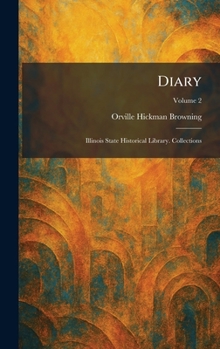
Diary: Illinois State Historical Library. Collections

The "Diary" of Orville Hickman Browning stands as a monumental primary source for understanding the political and social fabric of mid-19th-century America. As a prominent Illinois lawyer, United States Senator, and Secretary of the Interior, Browning occupied a unique vantage point during the nation's most transformative years. This second volume continues the detailed chronicle of his life and career, offering an intimate look at the internal dynamics of the federal government and the legal profession during the Reconstruction era.
Browning's reflections provide invaluable historical context regarding the challenges of post-Civil War governance, the evolution of the Republican and Democratic parties, and the personal relationships that shaped national policy. His close association with figures like Abraham Lincoln and Andrew Johnson allows readers to witness the private deliberations behind public events. Throughout the text, the "Diary" captures the daily rhythms of 19th-century life in both Illinois and Washington, D.C., blending personal observation with high-stakes political analysis. This work is an essential resource for scholars of American history, legal historians, and anyone seeking to understand the complexities of leadership and diplomacy during a period of intense national rebuilding.
This work has been selected by scholars as being culturally important, and is part of the knowledge base of civilization as we know it. This work was reproduced from the original artifact, and remains as true to the original work as possible. Therefore, you may see the original copyright references, library stamps (as most of these works have been housed in our most important libraries around the world), and other notations in the work.
This work is in the public domain in the United States of America, and possibly other nations. Within the United States, you may freely copy and distribute this work, as no entity (individual or corporate) has a copyright on the body of the work.
As a reproduction of a historical artifact, this work may contain missing or blurred pages, poor pictures, errant marks, etc. Scholars believe, and we concur, that this work is important enough to be preserved, reproduced, and made generally available to the public. We appreciate your support of the preservation process, and thank you for being an important part of keeping this knowledge alive and relevant.
Customer Reviews
ThriftBooks ® and the ThriftBooks ® logo are registered trademarks of Thrift Books Global, LLC
