


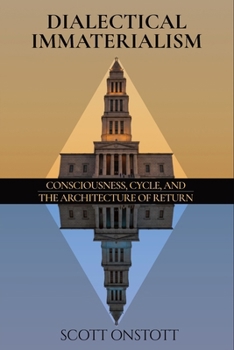
Dialectical Immaterialism: Consciousness, Cycle, and the Architecture of Return
No Customer Reviews

The summit is not the destination. It is the turning point between two movements.The structure that most urgently needs to change is not the one that failed. It is the one that succeeded so completely that the success became the constraint. The credential system that worked inflated itself into the credential system that distinguishes nothing. The acute medicine that worked produced the chronic disease burden it was never designed to manage. The individual who built the most thoroughgoing version of the self arrived at the boundary that the self cannot cross. The pattern is not moralizing and not metaphorical. It is structural, and it operates at every scale at which consciousness organizes itself. Dialectical Immaterialism names this structure and traces it across four registers: the philosophy of mind, the geometry of the three-pole cycle, the architecture of individual development, and the history of institutions and civilizations. The argument is developed on a specific philosophical ground: consciousness is not a product of the physical world but the ground in which it arises. That position is not the book's destination. It is the stable platform from which the structural analysis is conducted without importing assumptions that would decide the argument before it begins. The book traces the mechanism through two movements of equal architectural weight. The outbreath is the progressive development of the capacity to observe the structures that organize experience rather than simply to live inside them. It is the movement toward the witnessing position that philosophy, psychology, and contemplative traditions across cultures have documented in different vocabularies over centuries. The inbreath is the return to full engagement with the cycle from the witnessing position, with the cycle perceived. Most accounts of development describe the outbreath in detail and treat the witnessing position as the endpoint. Dialectical Immaterialism's central argument is that the witnessing position is the halfway mark, the turning point at which the second movement becomes available, not the destination at which the journey rests. The Engine: The antithesis is not imposed from outside the thesis. It is generated by the thesis reaching the limit of its own success. This mechanism is structural and has no villains. It does not require failure, corruption, or bad leadership. It requires only that the thesis be genuinely and thoroughly successful. The Two Movements: Most accounts of consciousness, development, and spiritual maturation describe one movement: the progressive loosening of identification with habitual structures of experience and the ascent toward the witnessing position. That movement is real, and Part II traces its geometry. What most accounts omit is the second movement of equal structural weight: the return to full engagement with the cycle from the witnessing position, with the cycle perceived. Both movements are required. The breath that only exhales is not a breath at all. The Witnessing Position: The clarity of the witnessing position is genuine. The peace is real. The perspective it provides, looking across the cycle with its three poles visible as poles rather than experienced as fates, is not an illusion. The traditions have, in many formulations, treated it as the endpoint of development. Dialectical Immaterialism's argument is that they have its location wrong. It is the peak of the outbreath, the moment of maximum extension before the direction changes, and the structural prerequisite of the second movement.
Format:Paperback
Language:English
ISBN:B0HMFDRCKK
ISBN13:9798171997830
Release Date:October 2026
Publisher:Independently Published
Length:242 Pages
Weight:0.72 lbs.
Dimensions:0.6" x 6.0" x 9.0"
Customer Reviews
0 rating
Copyright © 2026 Thriftbooks.com
Terms of Use | Privacy Policy | Do Not Sell/Share My Personal Information | Cookie Notice | Cookie Preferences | Accessibility Statement
ThriftBooks ® and the ThriftBooks ® logo are registered trademarks of Thrift Books Global, LLC
ThriftBooks ® and the ThriftBooks ® logo are registered trademarks of Thrift Books Global, LLC
