


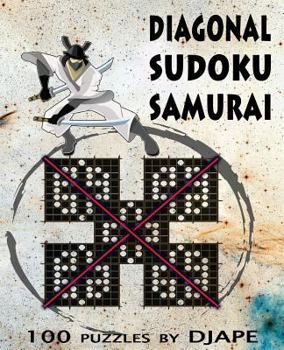
Diagonal Sudoku Samurai X: 100 puzzles

Abandon standard single-grid isolation and linear constraints. Engineered strictly for elite solvers requiring a massive escalation in spatial reasoning, this 100-grid compendium introduces the Diagonal Samurai X framework. These puzzles are meticulously constructed by the expert responsible for the Samurai Sudoku features published every Sunday in the Washington Post since 2006, providing a professional-grade mental workout designed to prevent deductive stagnation.
The Mechanics of Gattai-5 Diagonal InterdependencyTo navigate this matrix, solvers must manage the simultaneous flow of logic across five interlocking 9 9 grids and ten distinct diagonal axes. A Samurai X puzzle is a single mathematical macro-structure where the four peripheral grids overlap the corners of a central core. In this architecture, every diagonal-marked clearly across the grids-must contain the digits 1 through 9 without repetition. These diagonal constraints create high-friction intersections that dictate the mathematical parameters of the shared 3 3 regions, requiring hyper-vigilant candidate filtering.
Mandatory Solving Technique: The CrossoverStandard elimination methods are insufficient for the higher difficulty tiers found in this collection. To break the most complex Gattai-5 locks, solvers must master the "Crossover" technique. This involves identifying how a diagonal constraint in one sub-grid mathematically restricts the candidate placement in an overlapping sub-grid. By tracking the path of a diagonal through the shared 3 3 boxes, you can isolate guaranteed digits that are otherwise invisible to standard row and column scanning.
Professional Deductive StandardsUtilizing the same rigorous construction standards seen in the Washington Post, every grid is mathematically verified to possess strictly one unique solution reachable through pure logic alone. Guesswork is strictly prohibited and will result in the total breakdown of the logic chain. The 100 puzzles are evenly sequenced across five difficulty levels, providing a structured pathway to mastery. Printed on high-quality, thick paper to accommodate heavy notation, this collection functions as the definitive resource for solvers who have outgrown standard grid formats.
Customer Reviews
ThriftBooks ® and the ThriftBooks ® logo are registered trademarks of Thrift Books Global, LLC
