


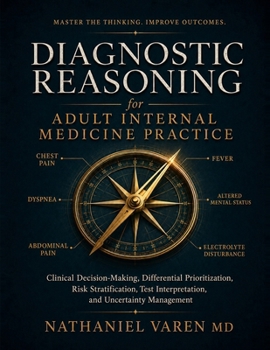
Diagnostic Reasoning for Adult Internal Medicine Practice: Clinical Decision-Making, Differential Prioritization, Risk Stratification, Test Interpreta

Master the thinking behind better diagnosis.
Diagnostic Reasoning for Adult Internal Medicine Practice is a structured, clinically grounded guide to the reasoning processes that connect patient presentation, evidence, probability, risk, testing, and action.
Rather than functioning as another disease encyclopedia, this book focuses on how clinicians think when the diagnosis is not yet certain. It examines the decisions that occur between first presentation and diagnostic conclusion: identifying meaningful clinical information, constructing and prioritizing differential diagnoses, estimating probability, recognizing dangerous alternatives, selecting appropriate investigations, interpreting results in context, and deciding when available evidence is sufficient to act.
Designed for medical students in clinical training, residents, physicians, and other clinicians, the book provides a practical framework for approaching the uncertainty and complexity of adult internal medicine.
Inside, readers will explore:
Foundations of diagnostic reasoning, including analytic and intuitive thinking, illness scripts, pattern recognition, Bayesian updating, cognitive bias, calibration, and metacognition
Clinical information synthesis, with emphasis on history, physical examination, data quality, temporal patterns, and problem representation
Differential diagnosis construction and prioritization, including probability, consequence, competing hypotheses, and dynamic reprioritization
Clinical decision-making under uncertainty, including thresholds for observation, testing, intervention, and diagnostic closure
Risk stratification and diagnostic urgency, with attention to instability, deterioration, triage, disposition, escalation, and safety
Diagnostic test selection and interpretation, including pretest probability, likelihood, predictive value, false-positive and false-negative results, serial measurements, and discordant findings
Diagnostic uncertainty and error prevention, including safety-netting, reassessment, communication, and diagnostic harm
Complex adult presentations, including multimorbidity, polypharmacy, atypical illness in older adults, chronic disease, and baseline abnormalities
Longitudinal diagnostic reasoning, emphasizing clinical evolution, response to intervention, recurrence, reassessment, and loop closure
A central theme throughout the book is that the most likely diagnosis is not always the most important diagnosis to address first. Effective diagnostic reasoning requires balancing probability with severity, reversibility, time sensitivity, patient context, and the consequences of being wrong.
The book also emphasizes that diagnostic tests do not provide meaning in isolation. Results must be interpreted alongside pretest probability, disease prevalence, clinical context, timing, technical limitations, and competing explanations.
Whether used as a sequential learning resource, a reference for difficult cases, or a framework for teaching and case discussion, Diagnostic Reasoning for Adult Internal Medicine Practice offers a disciplined approach to making defensible clinical decisions when information is incomplete, conflicting, or evolving.
For readers who want to move beyond memorizing diagnoses and develop a more structured, probability-aware, risk-conscious approach to clinical reasoning.
Customer Reviews
ThriftBooks ® and the ThriftBooks ® logo are registered trademarks of Thrift Books Global, LLC
