


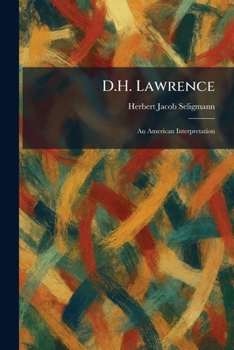
D.H. Lawrence: An American Interpretation

"D.H. Lawrence: An American Interpretation" is an insightful critical study that examines the literary contributions and philosophical depth of the renowned British author from a distinctively American perspective. Herbert J. Seligmann explores the raw emotional power and radical honesty that defined Lawrence's novels, poems, and essays, positioning him as a pivotal figure in the modernist movement.
The work investigates Lawrence's recurring themes, including the conflict between industrial civilization and the primal human spirit, the complexities of interpersonal relationships, and the search for authentic living. Seligmann's analysis provides a vital contextual framework for understanding how Lawrence's provocative ideas were received and interpreted outside of his native England. By focusing on the intrinsic value of Lawrence's artistry and his quest to redefine the boundaries of narrative expression, this book remains a significant contribution to the history of literary criticism. It offers readers a profound look at the enduring impact of "D.H. Lawrence" on the literary landscape of the early twentieth century.
This work has been selected by scholars as being culturally important, and is part of the knowledge base of civilization as we know it. This work was reproduced from the original artifact, and remains as true to the original work as possible. Therefore, you may see the original copyright references, library stamps (as most of these works have been housed in our most important libraries around the world), and other notations in the work.
This work is in the public domain in the United States of America, and possibly other nations. Within the United States, you may freely copy and distribute this work, as no entity (individual or corporate) has a copyright on the body of the work.
As a reproduction of a historical artifact, this work may contain missing or blurred pages, poor pictures, errant marks, etc. Scholars believe, and we concur, that this work is important enough to be preserved, reproduced, and made generally available to the public. We appreciate your support of the preservation process, and thank you for being an important part of keeping this knowledge alive and relevant.
Customer Reviews
ThriftBooks ® and the ThriftBooks ® logo are registered trademarks of Thrift Books Global, LLC
