


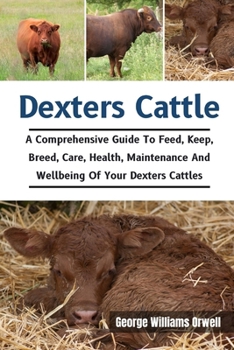
Dexters Cattle: A Comprehensive Guide To Feed, Keep, Breed, Care, Health, Maintenance And Wellbeing Of Your Dexters Cattles
No Customer Reviews

Dexter cattle are a unique and versatile breed celebrated for their adaptability, manageable size, and dual-purpose capabilities. Originating from Ireland, these small yet sturdy animals have carved a niche for themselves in farming systems worldwide. Dexter cattle are equally suited for meat and milk production, making them an excellent choice for small-scale farmers, homesteaders, and those seeking sustainable agricultural practices. This chapter explores their origin, history, physical characteristics, and the traits that make them stand out among cattle breeds.
1.1 Origin and History
Dexter cattle trace their origins to the lush, green hills of Ireland. They are believed to have descended from the ancient Celtic cattle, which were prized for their hardiness and ability to thrive in challenging conditions. The breed's name comes from Mr. Dexter, an agent of Lord Hawarden in County Tipperary during the late 18th century, who played a significant role in standardizing and promoting these animals.
Dexter cattle were initially bred as a small, hardy, and multi-purpose breed suitable for small farms and subsistence agriculture. Their compact size made them ideal for smallholders with limited grazing land, while their dual-purpose nature allowed them to provide both milk and meat, ensuring a steady source of food and income for rural families.
In the late 19th century, Dexter cattle began to attract attention beyond Ireland. They were exported to England, where they gained popularity among hobby farmers and estate owners for their manageable size and gentle temperament. The breed's fame continued to grow, and by the early 20th century, they had reached the shores of North America, Australia, and other parts of the world.
Despite their historical significance, the breed faced challenges in the mid-20th century, including competition from larger, more commercially oriented breeds. However, renewed interest in sustainable farming and heritage breeds has revitalized the popularity of Dexter cattle. Today, they are recognized not only for their agricultural value but also as a living link to Ireland's rural heritage.
1.2 Physical Characteristics
Dexter cattle are one of the smallest breeds of cattle, making them highly distinctive and easily recognizable. Their compact size, combined with their sturdy build, contributes to their adaptability and efficiency in various farming environments.
Size and Weight
Dexter cattle are considerably smaller than most other cattle breeds. Mature cows typically weigh between 600 and 700 pounds (272 to 318 kilograms), while bulls range from 1,000 to 1,100 pounds (454 to 500 kilograms). Their height at the shoulder usually measures around 36 to 44 inches (91 to 112 centimeters). This diminutive size makes them ideal for small farms and homesteads, where space and resources may be limited.
Coat and Color
Dexter cattle come in three primary coat colors: black, red, and dun. Black is the most common, followed by red and then the lighter dun shade. Their coats are typically sleek in summer and develop a thicker, insulating layer during colder months, a testament to their adaptability to various climates.
Body Structure
Dexter cattle have a compact and muscular build, with well-proportioned bodies that emphasize their utility as a dual-purpose breed. Their legs are short but sturdy, supporting their hardy nature and ability to navigate rugged terrain. They have broad, deep chests and well-sprung ribs, contributing to their robust constitution.
Horns
Many Dexter cattle are naturally horned, with medium-sized, outward-curving horns. However, polled (hornless) varieties also exist due to selective breeding. Both horned and polled Dexters are popular among farmers, with the choice often coming down to personal preference or specific management practices.
1.1 Origin and History
Dexter cattle trace their origins to the lush, green hills of Ireland. They are believed to have descended from the ancient Celtic cattle, which were prized for their hardiness and ability to thrive in challenging conditions. The breed's name comes from Mr. Dexter, an agent of Lord Hawarden in County Tipperary during the late 18th century, who played a significant role in standardizing and promoting these animals.
Dexter cattle were initially bred as a small, hardy, and multi-purpose breed suitable for small farms and subsistence agriculture. Their compact size made them ideal for smallholders with limited grazing land, while their dual-purpose nature allowed them to provide both milk and meat, ensuring a steady source of food and income for rural families.
In the late 19th century, Dexter cattle began to attract attention beyond Ireland. They were exported to England, where they gained popularity among hobby farmers and estate owners for their manageable size and gentle temperament. The breed's fame continued to grow, and by the early 20th century, they had reached the shores of North America, Australia, and other parts of the world.
Despite their historical significance, the breed faced challenges in the mid-20th century, including competition from larger, more commercially oriented breeds. However, renewed interest in sustainable farming and heritage breeds has revitalized the popularity of Dexter cattle. Today, they are recognized not only for their agricultural value but also as a living link to Ireland's rural heritage.
1.2 Physical Characteristics
Dexter cattle are one of the smallest breeds of cattle, making them highly distinctive and easily recognizable. Their compact size, combined with their sturdy build, contributes to their adaptability and efficiency in various farming environments.
Size and Weight
Dexter cattle are considerably smaller than most other cattle breeds. Mature cows typically weigh between 600 and 700 pounds (272 to 318 kilograms), while bulls range from 1,000 to 1,100 pounds (454 to 500 kilograms). Their height at the shoulder usually measures around 36 to 44 inches (91 to 112 centimeters). This diminutive size makes them ideal for small farms and homesteads, where space and resources may be limited.
Coat and Color
Dexter cattle come in three primary coat colors: black, red, and dun. Black is the most common, followed by red and then the lighter dun shade. Their coats are typically sleek in summer and develop a thicker, insulating layer during colder months, a testament to their adaptability to various climates.
Body Structure
Dexter cattle have a compact and muscular build, with well-proportioned bodies that emphasize their utility as a dual-purpose breed. Their legs are short but sturdy, supporting their hardy nature and ability to navigate rugged terrain. They have broad, deep chests and well-sprung ribs, contributing to their robust constitution.
Horns
Many Dexter cattle are naturally horned, with medium-sized, outward-curving horns. However, polled (hornless) varieties also exist due to selective breeding. Both horned and polled Dexters are popular among farmers, with the choice often coming down to personal preference or specific management practices.
Format:Paperback
Language:English
ISBN:B0DWD3FWZT
ISBN13:9798309272525
Release Date:February 2025
Publisher:Independently Published
Length:132 Pages
Weight:0.41 lbs.
Dimensions:0.3" x 6.0" x 9.0"
Customer Reviews
0 rating
Copyright © 2026 Thriftbooks.com Terms of Use
| Privacy Policy | Do Not
Sell/Share My Personal Information | Cookie Policy | Cookie Preferences | Accessibility Statement
ThriftBooks® and the ThriftBooks® logo are registered trademarks of Thrift Books Global, LLC
ThriftBooks® and the ThriftBooks® logo are registered trademarks of Thrift Books Global, LLC
