


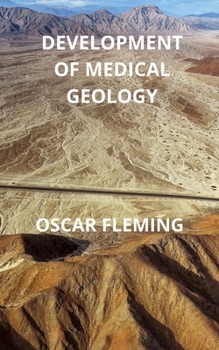
Development of Medical Geology
No Customer Reviews

In the field of health, the current global trend is to confirm that the population is facing new challenges such as emerging diseases, mainly non-communicable, associated with environmental exposures to chemicals, or the search for tools to achieve the 2030 targets. United Nations. In this context, exposure of people to certain chemicals plays an important role, especially metals in complex situations such as those they face in polluted cities, or contamination of water, soil and air in general. All of these are problems with global repercussions, as well as global warming and diseases associated with exposure to toxic elements in small but prolonged doses. These future challenges raise concerns about the tools to be considered in assessing the risk specifically associated with exposure to metals, given that our planet is in a constant process of change and that today we are facing mobilization. natural pollutants, not only due to anthropogenic action but also due to natural phenomena such as floods, alluvium or droughts in geographical places where historically they have not been observed or have been rare.
Therefore, there is an update of the methodology and a review of the tools to be considered for different scenarios in assessing the risks due to exposure to chemicals.
There are various situations for which the potential exposure of populations to chemical agents must be assessed, the most complex being those that force us to deal with certain contaminants, such as metals and metalloids, some of which have the characteristics of trace elements and others of toxicity. A natural and sometimes anthropogenic origin.
Among these pollutants are relevant metals and metalloids (ie arsenic, lead, mercury, cadmium) and other elements such as fluoride, because they are present in the earth's crust and because they are part of the natural pollutants that we can find daily in the soil., air and water, means by which they are able to move in the human being and enter the body through the airways, digestive tract or dermis. But it is important to ask whether or not this agent will be bioavailable to that population, at what dose it could pose a risk, and how it will have an impact on health. These and other questions are the ones that need to be addressed on a daily basis in the field of health and the environment in order to guarantee safety or determine the risk of a given situation.
Therefore, there is an update of the methodology and a review of the tools to be considered for different scenarios in assessing the risks due to exposure to chemicals.
There are various situations for which the potential exposure of populations to chemical agents must be assessed, the most complex being those that force us to deal with certain contaminants, such as metals and metalloids, some of which have the characteristics of trace elements and others of toxicity. A natural and sometimes anthropogenic origin.
Among these pollutants are relevant metals and metalloids (ie arsenic, lead, mercury, cadmium) and other elements such as fluoride, because they are present in the earth's crust and because they are part of the natural pollutants that we can find daily in the soil., air and water, means by which they are able to move in the human being and enter the body through the airways, digestive tract or dermis. But it is important to ask whether or not this agent will be bioavailable to that population, at what dose it could pose a risk, and how it will have an impact on health. These and other questions are the ones that need to be addressed on a daily basis in the field of health and the environment in order to guarantee safety or determine the risk of a given situation.
Format:Paperback
Language:English
ISBN:B09XZMCMY4
ISBN13:9798805949693
Release Date:April 2022
Publisher:Independently Published
Length:206 Pages
Weight:0.46 lbs.
Dimensions:0.4" x 5.0" x 8.0"
Customer Reviews
0 rating
Copyright © 2026 Thriftbooks.com Terms of Use
| Privacy Policy | Do Not
Sell/Share My Personal Information | Cookie Policy | Cookie Preferences | Accessibility Statement
ThriftBooks® and the ThriftBooks® logo are registered trademarks of Thrift Books Global, LLC
ThriftBooks® and the ThriftBooks® logo are registered trademarks of Thrift Books Global, LLC
