


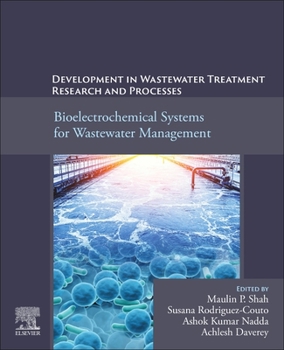
Development in Wastewater Treatment Research and Processes: Bioelectrochemical Systems for Wastewater Management
No Customer Reviews

Industrial wastewater contains a large variety of compounds, such as hazardous organic pollutants, heavy metals, salts and nutrients, which makes its treatment challenging. On the other hand, the sewage treatment with existing technologies is not cost-effective due to high energy demand and contributes to greenhouse gas emission. Thus, the use of conventional water treatment methods is neither sustainable nor always effective. In this sense, BESs has emerged as a promising technology to treat complex industrial wastewater with a sustainable manner. Development in Wastewater Treatment Research and Processes: Bioelectrochemical Systems for Wastewater Management analyses and discusses the potential of microbial and electrochemical based hybrid processes for the treatment of complex industrial wastewater along with the recovery of valuable compounds and water reutilization. The most significant advantages of BES are high effectiveness, low toxicity, gentle operation conditions, environmentally friendly treatment without sludge accumulation and energy conservation. Bioelectrochemical systems (BES) are emerging as an exciting platform to convert chemical energy of organic wastes into electricity or hydrogen or value-added chemical commodities. In addition, recent and future trends in BES are highlighted.
Format:Paperback
Language:English
ISBN:0323885055
ISBN13:9780323885058
Release Date:November 2022
Publisher:Elsevier
Length:298 Pages
Weight:1.14 lbs.
Dimensions:0.6" x 7.5" x 9.3"
Related Subjects
Engineering Science Science & Math Science & Scientists Science & Technology TechnologyCustomer Reviews
0 rating
Copyright © 2026 Thriftbooks.com
Terms of Use | Privacy Policy | Do Not Sell/Share My Personal Information | Cookie Policy | Cookie Preferences | Accessibility Statement
ThriftBooks ® and the ThriftBooks ® logo are registered trademarks of Thrift Books Global, LLC
ThriftBooks ® and the ThriftBooks ® logo are registered trademarks of Thrift Books Global, LLC
