


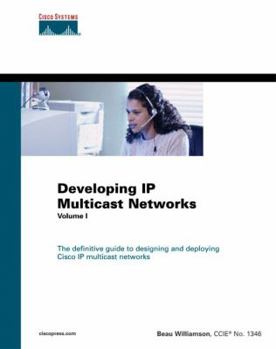
Developing Ip Multicast Networks (The Cisco Press Design and Implementation Series)

Select Format
Select Condition 
Book Overview
The definitive guide to designing and deploying Cisco IP multicast networks Clear explanations of the concepts and underlying mechanisms of IP multicasting, from the fundamentals to advanced design... This description may be from another edition of this product.
Format:Hardcover
Language:English
ISBN:1578700779
ISBN13:9781578700776
Release Date:January 1999
Publisher:Cisco Systems
Length:592 Pages
Weight:2.75 lbs.
Dimensions:9.3" x 1.5" x 7.5"
Customer Reviews
5 ratings
Good foundational book, even in 2008
Published by Thriftbooks.com User , 18 years ago
I was skeptical about buying a book this old, but I just finished it and am still slightly amazed at how little has changed in multicast technology in ~8 years. I have read Doyle's multicast coverage, listened to InternetworkExpert's excellent "class on demand" (CoD) on the topic many times, and worked through over half of their 20 CCIE lab scenarios, all of which have multicast sections. This doesn't make me an expert by any means, but I know enough now to recognize that the material in this book is still worth reading. The differences between this book and Doyle's (2004) are: - Williamson dedicates a lot more effort to explaining the mroute table. This was my single biggest stumbling block in multicast routing - Doyle, IMO, gives IGMP a better treatment - Doyle goes over mtrace and mstat - Williamson spreads the information out over more pages via liberal usage of config snips and diagrams, often one per page. This allows him to go into *brutal, painful and excruciating* detail about every line in the mroute table, every flag, every state transition, etc. - Williamson does a more thorough job of explaining exactly what happens in PIM-SM networks (100+ pages to Doyle's ~25) - Doyle goes over Anycast RP and gives a better explanation of MSDN, which appears to have been rather cutting edge when Williamson put finger to keyboard I finished the book in about a week of serious effort, but I skipped the following chapters (Cisco has not put much effort into the technologies described), leaving me with about 400 pages of groovyness: DVMRP CBT MOSPF Connecting to DVMRP Networks and several sections of other chapters To be sure, some things have changed. I didn't see any mention of the "ip pim autorp listener" command, which negates the need for sparse-dense mode when configuring Auto-RP (can't recall if Doyle mentioned that either). Also, in current versions of IOS one *does* need to specify the RP on the RP itself, whereas Williamson (and Doyle) explicitly say this is not the case (they were both right at the time of print, Cisco has changed this). Overall however, I would say that easily >95% of the material is solid here. <br /> <br />So which book to buy? Well if you're serious about the CCIE and/or running a multicast network you'll get both, and read them both several times. I do hope Williamson updates the book though, as he alludes to several draft proposals, and gives a "state of the multicast internet" address that I would like to know more about without digging through two dozen RFCs. Also, the few things that have changed would be a boon to the book.
Absolutely the best Multicast book available
Published by Thriftbooks.com User , 21 years ago
This is the best multicast book on the market. It is a must have whether you are preparing for the CCIE Lab or just want to understand multicast.The explanation was simple and clear. There are tons of configuration examples covering pretty much all kinds of scenarios. The author actually explained every single line of the configurations.I bought this book for my Lab exam, and after two days of reading, 99.99% of my questions were answered (the only one I still have is I actually made PIM-DM work in a hub-spoke frame relay network. The prune message from one spoke was actually seen by the other spoke, I don't know why the hub would forward it out).I have to admit this is one of the best books I've read for a long time. Just like Jeff Doyle's TCP/IP Routing is the Bible of IGP, this book is the Bible of Multicast.
Simply A "Must-Have" For Lab Prep
Published by Thriftbooks.com User , 22 years ago
Beau's book is indeed the true Multicasting Bible. I was totally new to multicasting when I began my CCIE studies, and having achieved that certification yesterday, I can tell you that Beau's book really opened the door for me on a topic that just isn't covered well elsewhere. The only recommendation I'd make to readers is that if the first 10 chapters aren't quite sinking in, go through the actual configuration chapters (they're at the back of the book), and then reread the theory chapters. It worked for me.Chris BryantCCIE #12933
Excellent! The most precise book on IP Multicasting
Published by Thriftbooks.com User , 26 years ago
I read this book after reading a lot of materials from different web sites. I also read many books and this book addressed most topics that were out of sight for me. This book also has configuration issues and a lot of information that is not available else where. I would say that this is the best book on IP Multicasting I have ever read.
Good read- better than Parkhurst's
Published by Thriftbooks.com User , 26 years ago
This is a good book. It appears to be just what I was looking for. There are some typos. This is much better than Parkhurst's multicasting book.I like Williamson's style. Not too dry. I'm only half way through. I expect to have a firmer understanding of PIM-DM and PIM-SM after reading it all. The author apparently has much real-world IP multicasting experience. Highly recommended. In terms of CCIE-level usefulness, I put it on a par with Jeff Doyle's "Routing TCP/IP" book.
Copyright © 2026 Thriftbooks.com Terms of Use
| Privacy Policy | Do Not
Sell/Share My Personal Information | Cookie Policy | Cookie Preferences | Accessibility Statement
ThriftBooks® and the ThriftBooks® logo are registered trademarks of Thrift Books Global, LLC
ThriftBooks® and the ThriftBooks® logo are registered trademarks of Thrift Books Global, LLC
