


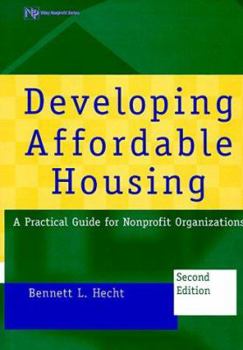
Developing Affordable Housing: A Practical Guide for Nonprofit Organizations (Wiley Nonprofit Law, Finance and Management Series)

Select Format
Select Condition 
Book Overview
Over the past fifteen years, the role of nonprofits in developing housing for those with low and moderate incomes has changed dramatically. Once supporting players, community development corporations, tenant associations, and other nonprofit organizations have now assumed the lead, filling the gap left by shrinking government commitment to become the nation's primary producers of affordable rental and home ownership opportunities. With the growing involvement of these various groups comes a new set of issues and concerns for them to handle, all of which are addressed in this revised and expanded edition of Developing Affordable Housing. Written by Bennett L. Hecht, a professional with extensive experience in nonprofit real estate development, this comprehensive resource provides cutting-edge tools and strategies for creating long-term stability, meeting community housing needs, and taking advantage of economic opportunities. Demystifying affordable housing development for those considering it for the first time, as well as for those seeking to expand into different types of housing production, it offers invaluable insights into possible financing sources and long-term management strategies that will make planned affordable housing developments effective and successful. Taking you step-by-step through the entire development process, Developing Affordable Housing, Second Edition covers all the bases, from putting together the development team to determining project feasibility to obtaining site control. Along with details on using Hope 6 funds for neighborhood revitalization programs, it contains a new chapter on joint ventures that includes specifics on limited liability corporations (LLCs). Packed with numerous checklists, step-by-step procedures, sample contracts, and model documents designed to help save time, effort, and expense, Developing Affordable Housing has all the information on: Raising capital--loans, grants, equity, public housing funds Property development--deposit and escrow, closing and recording costs, settlements, tenancies, risk of loss, purchaser inspection Prepurchase considerations--applying for financing and operating subsidies, determining ownership entity, interviewing management companies, developing plans for renting or selling units Settling on acquisition--title insurance, the settlement agent, property location survey, governmental regulations, building permits Financing and taxation--Low-Income Housing Tax Credit (LIHTC), Fannie Mae and Freddie Mac, Tax-Exempt Bonds A practical resource that features straightforward guidelines, sound advice, and up-to-date information, this is essential reading for any nonprofit looking to sponsor, own, or manage affordable housing projects. This comprehensive guide, now revised and expanded, covers the fundamentals of nonprofit real estate development, from financing and purchase contracts to site control and ownership entity. Packed with numerous checklists, sample contracts, and model documents, the Second Edition addresses such essential topics as: Assembling the development team Projecting costs, income, and expenses Raising capital Establishing partnerships and joint ventures Purchasing, constructing, and rehabilitating property Maintaining an ownership or rental community "Developing Affordable Housing does what no other book I know has done--lays out in a practical, complete way all the steps nonprofits need to successfully develop affordable housing ... It should become required reading for anyone attempting their first or their fortieth housing project." --F. Barton Harvey III, Chairman of the Board and CEO, The Enterprise Foundation "Many of today's most creative solutions to local affordable housing challenges arise from the innovative collaborations nonprofit organizations form with local gov
Format:Paperback
Language:English
ISBN:0471298441
ISBN13:9780471298441
Release Date:February 1999
Publisher:Wiley
Length:720 Pages
Weight:3.30 lbs.
Dimensions:9.9" x 1.6" x 7.1"
Customer Reviews
1 rating
It's a great book, very informative
Published by Thriftbooks.com User , 26 years ago
This book is wonderful! It is very informative and interesting. Buy it! In bulk! Certainly worth my reading time.
Copyright © 2026 Thriftbooks.com Terms of Use
| Privacy Policy | Do Not
Sell/Share My Personal Information | Cookie Policy | Cookie Preferences | Accessibility Statement
ThriftBooks® and the ThriftBooks® logo are registered trademarks of Thrift Books Global, LLC
ThriftBooks® and the ThriftBooks® logo are registered trademarks of Thrift Books Global, LLC
