


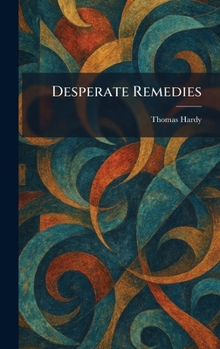
Desperate Remedies


Select Format
Select Condition 
Book Overview
"Desperate Remedies" is the compelling debut novel of Thomas Hardy, showcasing the early literary prowess of one of England's most celebrated authors. Blending elements of the Victorian sensation novel with gothic atmosphere and intricate plotting, the story follows Cytherea Graye, a young woman forced by financial hardship to accept a position as a lady's maid to the eccentric and mysterious Miss Aldclyffe.
As Cytherea navigates her new life, she finds herself entangled in a web of dark secrets, blackmail, and unrequited love. The narrative is driven by the arrival of the enigmatic Aeneas Manston, whose presence triggers a series of events involving murder and deception that threaten to destroy Cytherea's happiness. Hardy masterfully constructs a tale of suspense and psychological depth, exploring the rigid constraints of social class and the desperate measures individuals take to secure their futures.
A fascinating departure from the pastoral tragedies of his later career, "Desperate Remedies" offers readers a unique blend of melodrama and mystery. It remains a vital work for those seeking to understand the evolution of Hardy's style and his enduring interest in the complexities of human nature and Victorian society.
This work has been selected by scholars as being culturally important, and is part of the knowledge base of civilization as we know it. This work was reproduced from the original artifact, and remains as true to the original work as possible. Therefore, you may see the original copyright references, library stamps (as most of these works have been housed in our most important libraries around the world), and other notations in the work.
This work is in the public domain in the United States of America, and possibly other nations. Within the United States, you may freely copy and distribute this work, as no entity (individual or corporate) has a copyright on the body of the work.
As a reproduction of a historical artifact, this work may contain missing or blurred pages, poor pictures, errant marks, etc. Scholars believe, and we concur, that this work is important enough to be preserved, reproduced, and made generally available to the public. We appreciate your support of the preservation process, and thank you for being an important part of keeping this knowledge alive and relevant.
Customer Reviews
Surprisingly Good
Not your typical Hardy, which is almost a good thing
ThriftBooks ® and the ThriftBooks ® logo are registered trademarks of Thrift Books Global, LLC
