


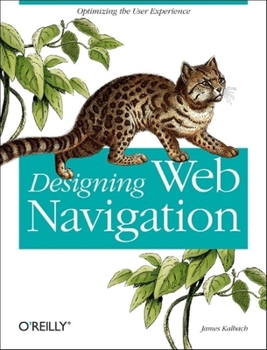
Designing Web Navigation: Optimizing the User Experience

Select Format
Select Condition 
Book Overview
Thoroughly rewritten for today's web environment, this bestselling book offers a fresh look at a fundamental topic of web site development: navigation design. Amid all the changes to the Web in the past decade, and all the hype about Web 2.0 and various "rich" interactive technologies, the basic problems of creating a good web navigation system remain. Designing Web Navigation demonstrates that good navigation is not about technology-it's about the ways people find information, and how you guide them.
Ideal for beginning to intermediate web designers, managers, other non-designers, and web development pros looking for another perspective, Designing Web Navigation offers basic design principles, development techniques and practical advice, with real-world examples and essential concepts seamlessly folded in. How does your web site serve your business objectives? How does it meet a user's needs? You'll learn that navigation design touches most other aspects of web site development. This book: Provides the foundations of web navigation and offers a framework for navigation design Paints a broad picture of web navigation and basic human information behavior Demonstrates how navigation reflects brand and affects site credibility Helps you understand the problem you're trying to solve before you set out to design Thoroughly reviews the mechanisms and different types of navigation Explores "information scent" and "information shape" Explains "persuasive" architecture and other design concepts Covers special contexts, such as navigation design for web applications Includes an entire chapter on tagging While Designing Web Navigation focuses on creating navigation systems for large, information-rich sites serving a business purpose, the principles and techniques in the book also apply to small sites. Well researched and cited, this book serves as an excellent reference on the topic, as well as a superb teaching guide. Each chapter ends with suggested reading and a set of questions that offer exercises for experiencing the concepts in action.
Ideal for beginning to intermediate web designers, managers, other non-designers, and web development pros looking for another perspective, Designing Web Navigation offers basic design principles, development techniques and practical advice, with real-world examples and essential concepts seamlessly folded in. How does your web site serve your business objectives? How does it meet a user's needs? You'll learn that navigation design touches most other aspects of web site development. This book: Provides the foundations of web navigation and offers a framework for navigation design Paints a broad picture of web navigation and basic human information behavior Demonstrates how navigation reflects brand and affects site credibility Helps you understand the problem you're trying to solve before you set out to design Thoroughly reviews the mechanisms and different types of navigation Explores "information scent" and "information shape" Explains "persuasive" architecture and other design concepts Covers special contexts, such as navigation design for web applications Includes an entire chapter on tagging While Designing Web Navigation focuses on creating navigation systems for large, information-rich sites serving a business purpose, the principles and techniques in the book also apply to small sites. Well researched and cited, this book serves as an excellent reference on the topic, as well as a superb teaching guide. Each chapter ends with suggested reading and a set of questions that offer exercises for experiencing the concepts in action.
Format:Paperback
Language:English
ISBN:0596528108
ISBN13:9780596528102
Release Date:October 2007
Publisher:O'Reilly Media
Length:394 Pages
Weight:1.96 lbs.
Dimensions:0.9" x 8.1" x 9.7"
Customer Reviews
4 ratings
Excellent Colorful and Insightful Resource
Published by Thriftbooks.com User , 17 years ago
In today's day and age where the Internet is a part of our everyday life, there has never been a time more appropriate now then to have really good navigation on your or your client's website. As sites grow more advanced and complex, it is vital to the success of your website that users are able to find what they need in a timely fashion without jumping through hoops to get there. Designing Web Navigation: Optimizing the User Experiencehelps you lay the ground work to achieve a great user interaction experience. This full-color O'Reilly book clearly explains the full process of designing web navigation in three parts: Foundations of Web Navigation, A Framework for Navigation Design, and Navigation in Special Contexts. In Foundations, the author writes an adequate analysis of various types of navigation systems, such as the search model, browse model, or the liquid information model to name only a few. He describes why poor navigation design will turn away users and may actually decrease the credibility of your website. Furthermore he touches on topics such as banner blindness where your users may not truly notice intentional site navigation, simply because back in their minds it looks like a vertical advertisement banner. In Framework, Kalbach evaluates different forms of navigation for different types of sites. He talks about the need to engage your users to help determine what style will work best for your target audience. Moreover, he discusses types of technologies that may be implemented such as back-end technologies and front-end technologies like CSS and JavaScript. James Kalbach does an excellent job describing every facet of this complex and sometimes daunting process in a very detailed yet easy to comprehend fashion. He backs up all the research he has done with references as well as providing great additional reading and other resources. The full-color diagrams and case studies of existing navigations on real-world websites prove invaluable to the reader. One small complaint I have is that for a book on designing navigation, the page numbers are quite small and difficult to glance at when you are flipping through the book. Aside from this small glitch, as it were, this book is a must have in every web developer or designer's library. Even if you consider yourself to be an expert at web page flow, you cannot go without learning a rule or two, and perhaps some great what not to dos in this book.
Useful book for making you understand navigation design
Published by Thriftbooks.com User , 18 years ago
This book's really targeted to make you think about how to make your site's visitors best able to easily and repeatedly find content you deem important. You won't find bits on CSS, Javascript, or Ajax. Instead you'll find out things such as selecting appropriate navigation menu styles for given contexts, information architectures, the impact of tagging systems, and some of the complexities around search. The book's beautifully laid out with lots of shots of real websites scattered across full color pages to help illustrate important points. The first chapters are pretty academic and can be pretty dry, but they provide good information on content/information architecture. The rest of the book is an easier read, but that doesn't mean you should skip the first chapters. Lots of good sidebars call out specific topics -- accessibility is a hot topic throughout the book and gets a lot of sidebar treatment. The book's full of gems such as how you should consider workflows in navigation (think shopping cart systems, e.g.), or the differences between "lingo" and vocabularies. There are also a bunch of great references to other works, and each chapter has some nice exercises which are actually pertinent and helpful in making the reader more aware of that chapter's points. I was surprised that globalization/localization didn't get more treatment in the book, but there are quite a few example screenshots and discussions around international websites. Overall it's a very interesting, thought-provoking book.
Carefully researched, precise and extremely useful
Published by Thriftbooks.com User , 18 years ago
This isn't a book in which the author has thrown in a grab bag of his experiences together and presented them with splashy graphics. Instead, Kalbach breaks out concepts, often presenting conflicting points of view (he mentions Alan Cooper's call to dispense with navigation entirely) and embellishes it with research from the fields of usability and human factors. This approach makes the book feel academic but it doesn't take away from the readability of the text at all. (In fact, it would make a pretty good textbook for a related course) At one point in the initial chapter, Kalbach quotes research from usability expert Jared Spool that suggests that users who use Search to find a page in a web site are much less likely to browse the site than if they found the page using the site's own navigational aids. This point is a critical one because it underpins Kalbach's focus on navigation. You can rely on Search to get users to your page, but the search engine now becomes the navigation of choice for the users - it has no vested interest in keeping users on your site. If you want your web site to be sticky, then design great navigation. A little later when explaining the types of navigation and constructing key questions to formulate when designing navigation, you have the epiphany that this book isn't just about web sites. Instead it is laying down the paradigm for the flow of any application - networked or otherwise.
Great Foundation Resource
Published by Thriftbooks.com User , 18 years ago
This handsome volume will help web designers learn how to analyze their business needs and translate them into a workable navigation system for their users. Unlike some other design books, James Kalbach doesn't shove his own design principals down the reader's throat. Instead, he cites use cases and usability studies that will help readers figure out which design approach will best suit their needs. Lots of screenshots from well-known websites, great layout and good organization make the book a pleasure to read. The book starts by explaining general principles, so even if you're new to the concept of interaction design, you'll quickly get up to speed. More advanced readers could skim the first chapters, and plunge in later, where they'll learn things like visual logic and information design. Each chapter ends with a good summary, thought-provoking questions that either reinforce or expand on the chapter's topics, and suggestions for further reading. Note: I do have one quibble with the layout. The page numbers are so small it made my eyes hurt. But everything else about the book's design is inviting and useful. Caution, though, this is not a coding book. You won't learn how to make pop-up menus or write clean CSS. It's meant to help readers learn how to make decisions about the look and feel of a website. Even though the book is focused on web navigation, "regular" software designers will benefit, too, since so much interaction design is driven by users' expectations that all software should work like the web.
Copyright © 2026 Thriftbooks.com Terms of Use
| Privacy Policy | Do Not
Sell/Share My Personal Information | Cookie Policy | Cookie Preferences | Accessibility Statement
ThriftBooks® and the ThriftBooks® logo are registered trademarks of Thrift Books Global, LLC
ThriftBooks® and the ThriftBooks® logo are registered trademarks of Thrift Books Global, LLC
