


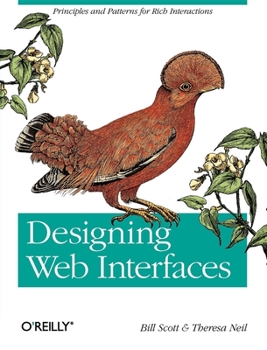
Designing Web Interfaces

Select Format
Select Condition 
Book Overview
Want to learn how to create great user experiences on today's Web? In this book, UI experts Bill Scott and Theresa Neil present more than 75 design patterns for building web interfaces that provide rich interaction. Distilled from the authors' years of experience at Sabre, Yahoo , and Netflix, these best practices are grouped into six key principles to help you take advantage of the web technologies available today. With an entire section devoted to each design principle, Designing Web Interfaces helps you: Make It Direct-Edit content in context with design patterns for In Page Editing, Drag & Drop, and Direct Selection Keep It Lightweight-Reduce the effort required to interact with a site by using In Context Tools to leave a "light footprint" Stay on the Page-Keep visitors on a page with overlays, inlays, dynamic content, and in-page flow patterns Provide an Invitation-Help visitors discover site features with invitations that cue them to the next level of interaction Use Transitions-Learn when, why, and how to use animations, cinematic effects, and other transitions React Immediately-Provide a rich experience by using lively responses such as Live Search, Live Suggest, Live Previews, and more
Designing Web Interfaces illustrates many patterns with examples from working websites. If you need to build or renovate a website to be truly interactive, this book gives you the principles for success.
Format:Paperback
Language:English
ISBN:0596516258
ISBN13:9780596516253
Release Date:February 2009
Publisher:O'Reilly Media
Length:332 Pages
Weight:1.57 lbs.
Dimensions:1.1" x 7.1" x 9.3"
Customer Reviews
4 ratings
Web Interfaces
Published by Thriftbooks.com User , 16 years ago
Reviewer: Dave Roman, GCPCUG member This book has 14 chapters, but they are only sub divisions of a different type of classification. The book is about interaction design on the web. They have divided this book up into six principles and since they took this approach I am going to review the principles. Principle One - Make It Direct What does that mean? This is covered in three chapters. They discuss direct in-page editing of content, moving objects around directly with the mouse (drag and drop), and applying actions to directly selected objects. Principle Two - Keep It Lightweight This area discusses Contextual Tools Principle Three - Stay on the Page Here they discuss ways to keep the user on the page including overlays, Inlays, Virtual Pages and Process Flow Principal Four - Provide an Invitation This area talks about providing an invitation to the user in a number of forms. Static invitations are offered on the page using visual techniques to invite interaction. Dynamic invitations come into play in response to what and where the user is interacting. Principal Five - Use Transitions This area could be entitled "Pay Attention" because it IS about getting your attention using movement and transition. They discuss transition patterns like "brighten and dim", "expand and collapse", "Self-Healing Fade", "Animation" and "spotlight". Then they go to the purpose of transition. What is the reason for using these powerful effects and where they are most effective. Principle Six - React Immediately This is all about what happens immediately after each interaction with the system. There should be an immediate reaction paired with the user's action. The system should always keep users informed about what is going on, through appropriate feedback within a reasonable time and is called Latency Reduction. They first talk about lookup patterns and then feedback patterns. The web is constantly changing, so the authors provide sites to keep you up to date, one of which is http://designingwebinterfaces.com It's a long book, but does a good job explaining what takes place in an interactive website. This is not a coding book, but more like a combination of the psychology of a web site and how to use this knowledge to make it easier for the user and also make it easier to buy a product or find the information they are looking for.
Best Practical Interaction Design Guide I've Read
Published by Thriftbooks.com User , 16 years ago
I've read a lot of books about designing functional user interfaces. This one is the best I've read. Even as a 12 year veteran of interaction design it had plenty for me to mine. It has up-to-the minute web 2.0 style AJAX interactions with directly actionable, pattern based examples. I bought one for everyone in the design group and made them read it! The authors' approach to defining interactions using patterns isn't new, but the all-in-one catalog of rich interactions is. Using this book I was able to quickly review interaction options for a particular use case and pick the right pattern. After a couple of weeks I finished standardizing interactions styles for our entire site, which helped designers and developers alike. Another hit from O'Reilly Press. If you are looking for a more philosophical definition of Interaction Design try Designing for Interaction: Creating Smart Applications and Clever Devices (VOICES)
Best organization of principles for designing Rich Internet Applications I have read so far
Published by Thriftbooks.com User , 17 years ago
This book absorbed me for the last weekend, and I have to say, it is the best book in the field of HCI I have come across since reading Tidwell's Designing Interfaces: Patterns for Effective Interaction Design. Of course, I like everything that happens to quote Cooper's About Face 3: The Essentials of Interaction Design and Raskin's The Humane Interface: New Directions for Designing Interactive Systems (ACM Press) - but this one gave me lots of new, practical ideas for the web, and a consistent terminology I can use to think and talk about Rich Internet Applications. Nicely organized and layouted, well-written, and, in my opinion, thought-through easy-to-grasp structure. I was studying many patterns in the Yahoo! pattern library online and I am glad that Bill Scott finally published a book with the same clarity and logic that I came to like online. Will become a standard in the company I work for and I am sure our clients will already start to "fear" discussions around the six principles when arguing with our consultants for what should be done and how :-) Great book.
Excellent book of rich interaction web patterns
Published by Thriftbooks.com User , 17 years ago
With tons of examples and many meaty details, Designing Web Interfaces is just brain candy for designers to read. My team is working on building out a pattern library right now and this book is a great resource of best practices, decision rationales, and "gotchas" for using specific patterns. This book also builds on the O'Reilly Designing Interfaces book (Jenifer Tidwell) but the two never step on each other. Great resource and highly readable.
Copyright © 2026 Thriftbooks.com Terms of Use
| Privacy Policy | Do Not
Sell/Share My Personal Information | Cookie Policy | Cookie Preferences | Accessibility Statement
ThriftBooks® and the ThriftBooks® logo are registered trademarks of Thrift Books Global, LLC
ThriftBooks® and the ThriftBooks® logo are registered trademarks of Thrift Books Global, LLC
