


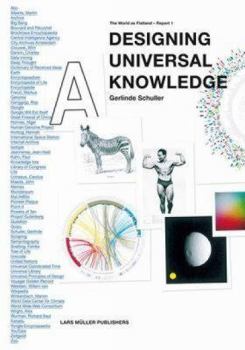
Designing Universal Knowledge: The World as Flatland - Report 1
No Customer Reviews

The development of modern communication and information technologies like the Internet and globalization have not only changed access and spread of the available knowledge but also the speed of collecting. The author examines collections of knowledge such as archives, encyclopedias, data collections, and libraries that make knowledge accessible worldwide. Who is collecting the world's knowledge? How is it structured and designed? Who determines the access of knowledge? Designers and researchers from different fields have set standards for the classification and design of complex data collections and thus exerted an enormous influence on how knowledge is communicated. This facilitates knowledge transfer, but it also increases the danger of manipulation. Along with these aspects, the book also explores the possibilities of "universal design" and presents new approaches to visualizing complex information. Gerlinde Schuller investigated the subject in interviews with Richard Saul Wurman, John Maeda, Nigel Holmes, Wim Crouwel, Paul Kahn, Jean-No?l Jeanneney, Rop Gonggrijp, Marion Winkenbach, Hannah Hurtzig and Martin Alberts. The book also includes essays by Alex Wright, Willem van Weelden, Markus Frenzl and Femke Snelting. AUTHOR: Gerlinde Schuller is head of the Information Design Studio in Amsterdam (NL). She is specialized in information design and visual journalism, she teaches information design and writes about the discipline. Her visual-editorial projects include the book 'Making the Impossible Possible' (2006) on economic superlatives and 'Designing universal knowledge' (2008) on information design. www.theworldasflatland.net 650 illustrations
Format:Hardcover
Language:English
ISBN:3037781491
ISBN13:9783037781494
Release Date:December 2008
Publisher:Lars Müller Publishers
Length:301 Pages
Weight:2.15 lbs.
Dimensions:9.7" x 1.0" x 6.7"
Customer Reviews
0 rating
Copyright © 2026 Thriftbooks.com
Terms of Use | Privacy Policy | Do Not Sell/Share My Personal Information | Cookie Policy | Cookie Preferences | Accessibility Statement
ThriftBooks ® and the ThriftBooks ® logo are registered trademarks of Thrift Books Global, LLC
ThriftBooks ® and the ThriftBooks ® logo are registered trademarks of Thrift Books Global, LLC
