


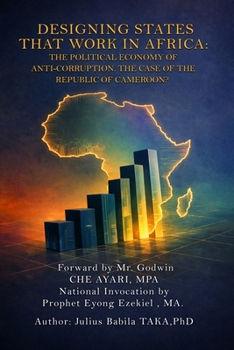
Designing States that Work in Africa

Select Format
Select Condition 
Book Overview
This book presents a powerful and deeply analytical exploration of corruption as a systemic force shaping governance, economic performance, and institutional legitimacy across Sub-Saharan Africa. Focusing on Cameroon as a central case study, the work reframes corruption not as isolated misconduct but as a parallel political economy embedded within state structures.
Drawing from political theory, institutional economics, and public administration, the author demonstrates how corruption distorts incentives, weakens institutions, and erodes public trust. The book argues that Africa's development challenges are not rooted in cultural or capacity deficiencies, but in flawed institutional design and misaligned governance systems.
Moving beyond diagnosis, the work introduces a comprehensive reform blueprint-the National Integrity and Development Strategy (2026-2040)-which integrates legal frameworks, digital governance systems, accountability mechanisms, and citizen oversight into a unified architecture for sustainable reform.
Combining scholarly rigor with practical policy insight, this book is essential reading for policymakers, academics, civil servants, and reform advocates seeking to understand and transform governance systems in Africa and beyond.
Customer Reviews
ThriftBooks ® and the ThriftBooks ® logo are registered trademarks of Thrift Books Global, LLC
