


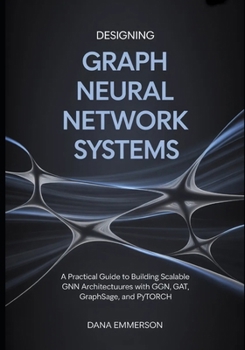
Designing Graph Neural Network Systems: A Practical Guide to Building Scalable GNN Architectures with GCN, GAT, GraphSAGE, and PyTorch
No Customer Reviews

As modern data systems become increasingly interconnected, the ability to model relationships between entities has become a critical requirement for building intelligent applications. Traditional machine learning and deep learning approaches often treat data as independent points, limiting their ability to capture complex relational structures found in real-world scenarios. Graph Neural Networks (GNNs) address this limitation by enabling models to learn directly from graph-structured data, unlocking new possibilities in domains such as recommendation systems, fraud detection, knowledge graphs, and social network analysis.
Designing Graph Neural Network Systems provides a comprehensive and practical guide to building scalable, production-ready graph-based AI systems. Rather than focusing solely on theory, this book emphasizes the architectural patterns, training strategies, and system design principles required to implement GNNs effectively in real-world environments.
The book begins by establishing a solid foundation in graph data modeling and relational learning, ensuring that readers understand how to represent complex systems as graphs and why this representation is essential for modern AI. From there, it explores core GNN architectures-including Graph Convolutional Networks (GCN), Graph Attention Networks (GAT), and GraphSAGE-examining their strengths, limitations, and appropriate use cases.
As you progress, the focus shifts to the practical challenges of building scalable systems. You will learn how to design efficient data pipelines for large graphs, implement mini-batch training strategies, and optimize performance using modern deep learning techniques. The book also provides hands-on guidance for working with PyTorch, enabling you to move from conceptual understanding to real implementation with confidence.
Beyond model development, this guide addresses critical aspects of deploying and maintaining graph-based systems in production environments. Topics such as system scalability, resource management, model evaluation, and debugging are covered in detail, ensuring that your solutions are not only functional but robust and reliable.
Throughout the book, real-world examples and case studies illustrate how GNNs can be applied to solve practical problems, helping you bridge the gap between research and application. By focusing on both the "how" and the "why," this book equips you with the knowledge needed to design systems that are adaptable, efficient, and aligned with real business and technical requirements.
What You Will LearnHow to model complex relational data using graph structuresHow to design and implement GNN architectures such as GCN, GAT, and GraphSAGEHow to build scalable training pipelines for large graph datasetsHow to use PyTorch to develop and optimize graph-based modelsHow to evaluate model performance and interpret graph-based predictionsHow to deploy and maintain graph neural network systems in productionHow to apply GNNs to real-world problems across multiple domainsWho This Book Is For
This book is intended for: Machine learning engineers and AI practitioners working with complex dataData scientists interested in graph-based modeling techniquesSoftware engineers building scalable AI systemsResearchers and practitioners exploring advanced deep learning architecturesA working knowledge of Python and familiarity with basic machine learning concepts will help you get the most out of this book.
Designing Graph Neural Network Systems provides a comprehensive and practical guide to building scalable, production-ready graph-based AI systems. Rather than focusing solely on theory, this book emphasizes the architectural patterns, training strategies, and system design principles required to implement GNNs effectively in real-world environments.
The book begins by establishing a solid foundation in graph data modeling and relational learning, ensuring that readers understand how to represent complex systems as graphs and why this representation is essential for modern AI. From there, it explores core GNN architectures-including Graph Convolutional Networks (GCN), Graph Attention Networks (GAT), and GraphSAGE-examining their strengths, limitations, and appropriate use cases.
As you progress, the focus shifts to the practical challenges of building scalable systems. You will learn how to design efficient data pipelines for large graphs, implement mini-batch training strategies, and optimize performance using modern deep learning techniques. The book also provides hands-on guidance for working with PyTorch, enabling you to move from conceptual understanding to real implementation with confidence.
Beyond model development, this guide addresses critical aspects of deploying and maintaining graph-based systems in production environments. Topics such as system scalability, resource management, model evaluation, and debugging are covered in detail, ensuring that your solutions are not only functional but robust and reliable.
Throughout the book, real-world examples and case studies illustrate how GNNs can be applied to solve practical problems, helping you bridge the gap between research and application. By focusing on both the "how" and the "why," this book equips you with the knowledge needed to design systems that are adaptable, efficient, and aligned with real business and technical requirements.
What You Will LearnHow to model complex relational data using graph structuresHow to design and implement GNN architectures such as GCN, GAT, and GraphSAGEHow to build scalable training pipelines for large graph datasetsHow to use PyTorch to develop and optimize graph-based modelsHow to evaluate model performance and interpret graph-based predictionsHow to deploy and maintain graph neural network systems in productionHow to apply GNNs to real-world problems across multiple domainsWho This Book Is For
This book is intended for: Machine learning engineers and AI practitioners working with complex dataData scientists interested in graph-based modeling techniquesSoftware engineers building scalable AI systemsResearchers and practitioners exploring advanced deep learning architecturesA working knowledge of Python and familiarity with basic machine learning concepts will help you get the most out of this book.
Format:Paperback
Language:English
ISBN:B0GY5F47NN
ISBN13:9798258410474
Release Date:April 2026
Publisher:Independently Published
Length:198 Pages
Weight:0.78 lbs.
Dimensions:0.4" x 7.0" x 10.0"
Customer Reviews
0 rating
Copyright © 2026 Thriftbooks.com
Terms of Use | Privacy Policy | Do Not Sell/Share My Personal Information | Cookie Policy | Cookie Preferences | Accessibility Statement
ThriftBooks ® and the ThriftBooks ® logo are registered trademarks of Thrift Books Global, LLC
ThriftBooks ® and the ThriftBooks ® logo are registered trademarks of Thrift Books Global, LLC
