


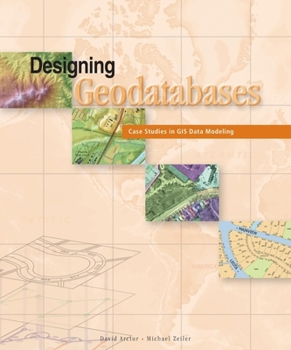
Designing Geodatabases: Case Studies in GIS Data Modeling


This guide to creating a dynamic GIS data model helps database managers design a schema that has comprehensive and descriptive query definitions, a user-friendly cartographic display, and increased performance standards. The five steps for taking a data model through its conceptual, logical, and physical phases, including modeling the user's view, defining objects and relationships, selecting geographic representations, matching geodatabase elements, and organizing the geodatabase structure are studied in detail. A look at nine decision points that deal with concerns common to all data modeling exercises, such as validating feature geometries, modeling linear networks, managing raster data, and labeling map features help database managers fine-tune their GIS data models. Several design models for a variety of applications are considered including addresses and locations, census units and boundaries, stream and river networks, and topography and the base map.
Format:Paperback
Language:English
ISBN:158948021X
ISBN13:9781589480216
Release Date:August 2004
Publisher:Esri Press
Length:393 Pages
Weight:2.46 lbs.
Dimensions:1.0" x 7.6" x 8.9"
Customer Reviews
4 ratings
A must for GIS model design & appraisal
Published by Thriftbooks.com User , 18 years ago
All chapters are clearly developed, explained, organized and illustrated. It is worth reading either as a first try into GIS database design or as an authoritative source for on-going model design appraisal. It only lacks a chapter devoted to network modeling such as those employed by electric, water or gas utilities. The water hydro model does address 'networks' but it is of a very different sort and is not apt for utility modeling.
Buen libro, buena compra
Published by Thriftbooks.com User , 18 years ago
la forma de desarrollo de cada tema esta muy bien explicado, mas alla de como armar una base de datos el libro proporciona un conocimineto claro para entender de los elementos en una base de datos y su relaciones. Da un esquema amplio que puede ser replicado para otros topicos donde sea necesario implementar sistemas parecidos.
Design ideas and scenarios
Published by Thriftbooks.com User , 19 years ago
This book provides a good introduction of steps and principles in designing geodatabases and the importance of information products and identifying thematic layers. The book presents 7 complex models: streams and river networks, census units and boundaries, addresses and locations, parcels and cadastre, surveying federal lands, using raster data, cartography and the base map. For each model they present the features, feature data sets, relationships, and topology rules. Readers working in these 7 areas will probably gain most from the book. I would have also liked simpler examples and more design principles on grouping features into feature data sets. One of the strengths of this book is in stressing the value of topology rules, and feature data sets are needed for topology rules. With a database background, I would have liked fuller exploration of database relationships and normality contrasted with GIS relationship classes, relates, and joins, since data is often "flattened" when put into GIS. Readers of this should probably start with Modeling Our World: The Esri Guide to Geodatabase design by Michael Zeiler.
mindshare is being sold here, not the book
Published by Thriftbooks.com User , 19 years ago
The subject is considerably more specialised that designing a relational data base. The book is part of ESRI's ongoing way to publicise geodatabases, and hence ultimately drive demand for their products. So keep in mind that what is really being sold here is not the book but mindshare. Yours. The text has extensive explanations as to what you might need in a geodatabase, as well as what is technically feasible to put in it. It also suggests that you consider what you want your users to be able to do. And use this in no small way to drive the design requirements. Software developers will recognise this as the gathering of scenarios from stakeholders. So you probably should canvas your potential users, if this is at all possible.
Copyright © 2026 Thriftbooks.com Terms of Use
| Privacy Policy | Do Not
Sell/Share My Personal Information | Cookie Policy | Cookie Preferences | Accessibility Statement
ThriftBooks® and the ThriftBooks® logo are registered trademarks of Thrift Books Global, LLC
ThriftBooks® and the ThriftBooks® logo are registered trademarks of Thrift Books Global, LLC
