


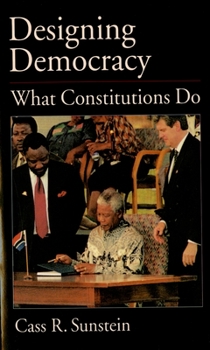
Designing Democracy: What Constitutions Do

Select Format
Select Condition 
Book Overview
"In modern nations, political disagreement is the source of both the gravest danger and the greatest security," writes Cass Sunstein. All democracies face intense political conflict. But is this conflict necessarily something to fear? In this provocative book, one of our leading political and legal theorists reveals how a nation's divisions of conviction and belief can be used to safeguard democracy. Confronting one explosive political issue after another, from presidential impeachment to the limits of religious liberty, from discrimination against women and gays to the role of the judiciary, Sunstein constructs a powerful new perspective from which to show how democracies negotiate their most divisive real-world problems. He focuses on a series of concrete concerns that go to the heart of the relationship between the idea of democracy and the idea of constitutionalism. Illustrating his discussion with examples from constitutional debates and court-cases in South Africa, Eastern Europe, Israel, America, and elsewhere, Sunstein takes readers through a number of highly charged questions: When should government be permitted to control discriminatory behavior by or within religious organizations? Does it make sense to govern on the basis of popular referenda? Can the right to have an abortion be defended? Can we defend Internet regulation? Should the law step in if children are being schooled in discriminatory preferences and beliefs? Should a constitution protect rights to food, shelter, and health care? Disputes over questions such as these can be fierce enough to pose a grave threat. But in a paradox whose elaboration forms the core of Sunstein's book, it is a nation's apparently threatening diversity of opinion that can ensure its integrity. Extending his important recent work on the way deliberation within like-minded groups can produce extremism, Sunstein breaks new ground in identifying the mechanisms behind political conflict in democratic nations. At the same time, he develops a profound understanding of a constitutional democracy's system of checks and balances. Sunstein shows how a good constitution, fostering a "republic of reasons," enables people of opposing ethical and religious commitments to reach agreement where agreement is necessary, while making it unnecessary to reach agreement when agreement is impossible. A marvel of lucid, subtle reasoning, DESIGNING DEMOCRACY makes invaluable reading for anyone concerned with the promises and pitfalls of the democratic experiment.
Format:Paperback
Language:English
ISBN:0195158407
ISBN13:9780195158403
Release Date:December 2002
Publisher:Oxford University Press
Length:292 Pages
Weight:0.95 lbs.
Dimensions:0.8" x 6.1" x 9.2"
Customer Reviews
1 rating
Intelligently designing democratic institutions
Published by Thriftbooks.com User , 24 years ago
First of all, I would like to say that I appreciate Cass Sunstein works a lot. Basically, I try to read everything he writes. Although here and there I would have a slightly different opinion (v.g. in free speech matters I tend to have a broader view of this fundamental right) Sunstein's books are always insightful, refreshing and profound. He has deeply influenced my view on constitutional issues. Cass Sunstein (in the line of Stephen Holmes, another author whom I also appreciate, combines progressive liberalism with classical liberalism, showing that liberal institutions, in a proper sense, have to be strong institutions, or else they will cease to be liberal. Another lesson we learn from Sunstein is about the value of democratic deliberation, based on reason and principle, and not in a social darwinism or "dawkinism" made of ideas such as "survival of the fittest", "natural selection", "naked preferences", "private power" or, less theoretically, "the law of the jungle". Sunstein's work is about escaping the "state of nature". It is basically against any kind of naturalistic reduction. This emphasis allows us to build democratic institutions that prevail over the markets and control all abuses of market power (including civil and social rights violations), while still apreciating the value of private property, free enterprise and the market, as ways of strenghning autonomy, producing wealth and decentralizing power. Sunstein also provides us critical tools to evaluate the way past injustices and patterns of subordination distort de baselines on which we build our judgements on liberty and equality, in a way that can provide a foundation of social and legal reform while keeping important liberal principles. He is able to integrate the insights of the critical schools of legal thought, while preserving a strong liberal commitment. In this way he keeps company with authors like Rawls, Dworkin, Habermas, Scanlon, Barry, Rosenfeld, etc., Consciously or not, Sunstein's books, including this one, are premissed in a sense of human dignity as a intelligent, rational and moral being, that largely transcends its consideration as an purely accidental configuration of selfish genes, resulting from matter, random mutations and natural selection. Human beings are seen as capable of intelligently designing democratic institutions based on discourse, dialogue, deliberation, reason and principle, much in the same line of the "intelligent design movement" (William Dembski, Michael Behe, Guilermo Gonzalez). Sunstein's is a "Republic of Reasons", not a "republic of selfish genes". However, Sunstein's work is not about bringuing teleology, or the good, but about the priority of right, and the belief of the creating, liberating and open ended ability of human beings to transcend past "teleologies" and give themselves more free and just institutions for the future.
Copyright © 2026 Thriftbooks.com Terms of Use
| Privacy Policy | Do Not
Sell/Share My Personal Information | Cookie Policy | Cookie Preferences | Accessibility Statement
ThriftBooks® and the ThriftBooks® logo are registered trademarks of Thrift Books Global, LLC
ThriftBooks® and the ThriftBooks® logo are registered trademarks of Thrift Books Global, LLC
