


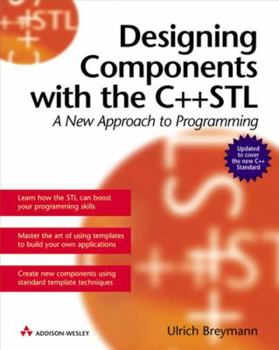
Designing Components with the C++ STL: A New Approach to Programming (Revised Edition)


A guide to learning to use the C++ Standard Template Library and create new reusable components based on that knowledge. It contains an introduction to STL including up-to-date features agreed upon by... This description may be from another edition of this product.
Format:Hardcover
Language:English
ISBN:0201674882
ISBN13:9780201674880
Release Date:November 2000
Publisher:Addison-Wesley Professional
Length:320 Pages
Weight:1.45 lbs.
Dimensions:9.2" x 0.8" x 6.9"
Customer Reviews
5 ratings
Excellent book on STL
Published by Thriftbooks.com User , 25 years ago
If you ever wondered why STL is the embodiment of research on generic programming (and what generic programming is anyway for C++ programmers), then this book is for you. It is not yet another STL reference by no means. It is not an introduction text either. This book will unveil the full power of STL and generic programming approach. Your relationship with STL is going to be different after reading this manuscript. Buy it, read it, and you will see why.
Great Reference for STL
Published by Thriftbooks.com User , 26 years ago
This book is a great STL reference. I use it frequently for information on the Standard algorithms. This is its best part. General information on the basic STL containers is weak.
A great book
Published by Thriftbooks.com User , 26 years ago
This book does a good job of explaining the basics of extending the STL with your own containers, predicates, iterators, and algorithms. One nice section is useful as a reference for the algorithms defined in . It explains in plainer language than the STL documenation that ships with VC++. I wish more time had been spent on the predicates in but the basics of predicates were covered in depth. The book uses examples that are relavent to the average programmer. One example in particular that I liked was an example implemenation of map and set like classes that used hash tables instead of trees. Since hash tables provide O(1) access instead of O(log N) for trees this is a very useful example when efficent access is more important than maintaining order.
A superbly authored treatment of the STL
Published by Thriftbooks.com User , 27 years ago
This book begins with an excellent treatise on how the standard template library is structured, using traditional C++ concepts. The author sets the stage for and provides an excellent explanation of the fundamental concept underlying the STLContainers Iterators AlgorithmsNumerous elments of "bonus" information abound in this book, such as the difference between prefix and postfix incrementing. The author is to be complimented for providing examples with useful comments on almost every line of code.Useful information on new header names and namespaces is appreciated. Unlike other treatments on this topic, examples are diverse and useful. It is annoying to read a book where almost every example is taken from some bizzare string manipulation. The author is to be complimented for solid examples from graph theory and sparse matrix computations.The book is a perfect length -- not a bible and not a lot of fluff -- just solid, useful, well-thought out and well presented information.Perhaps the only item missing (or at least missed in this reviewer's first reading) is performace-related information. For example, what are the performance implications of creating a vector via successive push_back calls vs. pre-sizing or reserving space and then using the overloaded index operator to access elements? For large arrays, or vectors of vectors, understaning how a contiguous area of memory is preserved has important performance ramifications.Other small tidbits of information might have been helpful, such as explaining the difference betweenusing namespace std;map> someMap;<p>and<p>map< string, int, less<string> > someMap;<p>(with maximal munching, >> is interpreted as a token in C++ ... you can tell I was burned by this) Although you don't need the 'less' in this case, it's arguably a good habit to get into. One day, you will get burned when you do need it!<p>Of course, performance-related info! rmation in a design-oriented book may not be appropriate -- perhaps a topic for another edition, which this reviewer would purchase in an instant.<p>In all, an excellent book which belongs in any serious C++ developer's library.
A very complex book
Published by Thriftbooks.com User , 27 years ago
This is very heady, it is definitely not a primer or tuturial. It is similar in nature to Sedgewick's Algorithms in C (or C++) but for STL. It has a few things many would find useful but quickly goes into complex, arcane areas.
Copyright © 2025 Thriftbooks.com
Terms of Use | Privacy Policy | Do Not Sell/Share My Personal Information | Cookie Policy | Cookie Preferences | Accessibility Statement
ThriftBooks ® and the ThriftBooks ® logo are registered trademarks of Thrift Books Global, LLC
ThriftBooks ® and the ThriftBooks ® logo are registered trademarks of Thrift Books Global, LLC
