


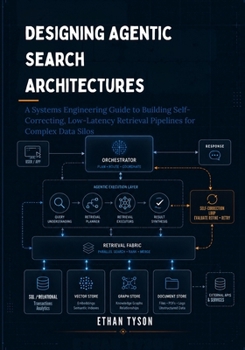
Designing Agentic Search Architectures: A Systems Engineering Guide to Building Self-Correcting, Low-Latency Retrieval Pipelines for Complex Data Silo

Enterprise search breaks when real data gets messy, scattered, outdated, permissioned, and too complex for a single vector lookup to handle.
Are your RAG systems missing critical context, returning weak answers, or slowing down when queries span documents, databases, APIs, and knowledge graphs? Do you need retrieval pipelines that can plan, evaluate, retry, route, and correct themselves before the final answer reaches the user?
Designing Agentic Search Architectures gives engineers and AI architects a practical systems guide for building modern retrieval pipelines that go beyond passive search. This book shows how to design agentic search systems that combine state machines, query expansion, multi-agent routing, corrective RAG, heterogeneous storage, MCP-based ingestion, caching, benchmarking, and security controls into production-ready retrieval workflows.
Inside, you'll learn how to build search architectures that can:
Decompose complex questions into executable retrieval plansRoute tasks across vector databases, SQL systems, graph databases, and external APIsUse corrective RAG loops to evaluate, prune, retry, and verify retrieved contextReduce latency and token cost with caching, streaming, and prompt compressionSecure enterprise retrieval with RBAC, auditing, tenant isolation, and controlled tool accessTest and benchmark agentic retrieval pipelines before deploymentWhat makes this book different is its systems-engineering focus. Instead of treating AI search as a simple prompt-and-vector problem, it shows how to structure retrieval as a controlled, observable, self-correcting architecture built for complex data silos.
This book is for AI engineers, software engineers, data engineers, solution architects, and technical leaders building serious RAG, agentic AI, enterprise search, and retrieval infrastructure.
Customer Reviews
ThriftBooks ® and the ThriftBooks ® logo are registered trademarks of Thrift Books Global, LLC
