


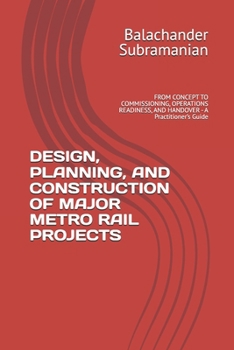
Design, Planning, and Construction of Major Metro Rail Projects: FROM CONCEPT TO COMMISSIONING, OPERATIONS READINESS, AND HANDOVER - A Practitioner's
No Customer Reviews

Urban metro rail systems are among the most complex infrastructure assets conceived by modern cities. They operate at the intersection of urban planning, civil engineering, systems engineering, public finance, governance, stakeholder management, and operational safety. Unlike conventional infrastructure projects, metro rail developments demand absolute precision in design integration, execution sequencing, safety assurance, systems compatibility, and long-term operability. This book has been written to serve as a comprehensive, end-to-end technical and managerial guide to the development of major metro rail projects - from the earliest concept and feasibility studies to final commissioning, operations readiness, and handover to the operator. Metro rail projects are not merely construction projects. They are city-shaping programs executed over decades, involving: Multilateral and sovereign fundingLand acquisition and resettlement at city scaleComplex underground and elevated constructionInterface-heavy systems engineeringPublic safety, operational resilience, and regulatory oversightPolitical, social, and environmental accountabilityFailures in metro projects rarely occur due to a lack of engineering capability alone. They arise from: Poor front-end planningInadequate design integrationWeak contract packagingMisaligned procurement strategiesInsufficient utility and traffic coordinationIneffective risk allocationLate-stage systems integration failuresThis book addresses these challenges holistically, presenting practical frameworks, proven methodologies, decision-making models, and real-world lessons drawn from global metro rail projects.
It is designed to be both: A reference manual for experienced professionalsA structured learning guide for emerging leaders in metro rail development
While numerous technical manuals exist for individual disciplines-civil works, rolling stock, signaling, traction power, or tunneling-very few resources explain how all these elements are planned, designed, procured, constructed, integrated, tested, commissioned, and handed over as a single system.
Major metro projects fail not because of isolated technical issues, but because: Interfaces are misunderstoodResponsibilities are fragmentedDesign intent is lost during constructionCommissioning is treated as an afterthoughtOperations readiness is underestimatedThis book takes a systems-first, lifecycle-based approach, recognizing that: Every design decision affects constructabilityEvery construction choice affects operationsEvery contract clause affects risk and accountabilityEvery interface is a potential failure pointWritten by a practitioner for practitioners, this book does not romanticize mega projects. Instead, it documents what actually works, what repeatedly fails, and how informed leadership can prevent avoidable mistakes. The content reflects best practices applicable to: Greenfield metro systemsNetwork expansionsBrownfield upgradesElevated, underground, and mixed-corridor systemsDesign-Bid-Build, EPC, and PPP delivery models
It is designed to be both: A reference manual for experienced professionalsA structured learning guide for emerging leaders in metro rail development
While numerous technical manuals exist for individual disciplines-civil works, rolling stock, signaling, traction power, or tunneling-very few resources explain how all these elements are planned, designed, procured, constructed, integrated, tested, commissioned, and handed over as a single system.
Major metro projects fail not because of isolated technical issues, but because: Interfaces are misunderstoodResponsibilities are fragmentedDesign intent is lost during constructionCommissioning is treated as an afterthoughtOperations readiness is underestimatedThis book takes a systems-first, lifecycle-based approach, recognizing that: Every design decision affects constructabilityEvery construction choice affects operationsEvery contract clause affects risk and accountabilityEvery interface is a potential failure pointWritten by a practitioner for practitioners, this book does not romanticize mega projects. Instead, it documents what actually works, what repeatedly fails, and how informed leadership can prevent avoidable mistakes. The content reflects best practices applicable to: Greenfield metro systemsNetwork expansionsBrownfield upgradesElevated, underground, and mixed-corridor systemsDesign-Bid-Build, EPC, and PPP delivery models
Format:Paperback
Language:English
ISBN:B0GD8RSV3T
ISBN13:9798241930224
Release Date:December 2025
Publisher:Independently Published
Length:686 Pages
Weight:1.99 lbs.
Dimensions:1.4" x 6.0" x 9.0"
Customer Reviews
0 rating
Copyright © 2026 Thriftbooks.com
Terms of Use | Privacy Policy | Do Not Sell/Share My Personal Information | Cookie Policy | Cookie Preferences | Accessibility Statement
ThriftBooks ® and the ThriftBooks ® logo are registered trademarks of Thrift Books Global, LLC
ThriftBooks ® and the ThriftBooks ® logo are registered trademarks of Thrift Books Global, LLC
