


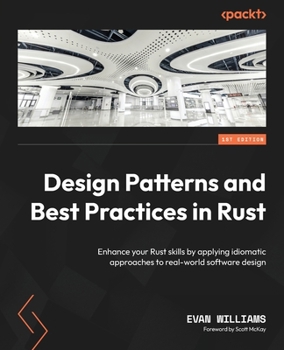
Design Patterns and Best Practices in Rust: Enhance your Rust skills by applying idiomatic approaches to real-world software design

Write safer, more maintainable Rust code by identifying anti-patterns, applying idiomatic design patterns tailored to ownership, borrowing, and the type system, and learning when to adapt or avoid traditional solutions.
Free with your book: DRM-free PDF version + access to Packt's next-gen Reader*
Key Features:
- Leverage traits, ownership, borrowing, and lifetimes to structure expressive, modular Rust code
- Avoid common Rust anti-patterns and design pitfalls with clear, Rust-specific guidance
- Design practical Rust applications using Rust-native and adapted design patterns
Book Description:
Many Rust developers run into problems when they try to apply familiar object-oriented or cross-language patterns to Rust projects. These mismatches often lead to confusing compiler errors, awkward workarounds, or brittle code. This book helps you avoid those traps by thinking in Rust and applying idiomatic design patterns that embrace ownership, borrowing, and type safety.
The book begins with anti-patterns and common mistakes Rust developers often encounter, including misusing object-oriented thinking, over-relying on Clone, or treating the borrow checker as an obstacle. From there, you'll explore how to rethink traditional design solutions for Rust, including creational, structural, and behavioral design patterns. You'll also dive into architectural strategies, type-driven design, and Rust-specific techniques such as TypeState. The final chapter brings these ideas together into a design mindset rooted in idiomatic Rust.
By the end of this book, you'll know how to avoid costly mistakes, apply effective patterns confidently, and design Rust applications that are clean, scalable, and reliable.
*Email sign-up and proof of purchase required
What You Will Learn:
- Design maintainable applications using idiomatic Rust patterns
- Recognize Rust anti-patterns that lead to messy or inefficient code
- Adapt creational, structural, and behavioral design patterns to Rust
- Leverage the type system to catch logic errors at compile time
- Structure code effectively with modules, traits, and clear interfaces
- Work with ownership, borrowing, and the type system to simplify data handling
- Implement functional techniques for clearer, expressive Rust code
Who this book is for:
Rust developers ready to move beyond the basics and improve how they design and structure code will benefit from this book. If you're comfortable building simple applications and using tools like Cargo, this book will help you write cleaner, more idiomatic, and reliable software.
It's ideal for those looking to understand which patterns work in Rust, how to avoid common traps, and how to tackle more complex, real-world projects with confidence.
Table of Contents
- Why Is Rust Different?
- Anti-Pattern: Designing for Object Orientation
- Anti-Pattern: Using Clone & Rc Everywhere
- Don't Fight the Borrow Checker
- Creational Patterns: Making Things
- Structural Patterns: Connecting and Aggregating Components
- Behavioral Patterns 1: Taking Action
- Behavioral Patterns 2: Keeping Track
- Architectural Patterns
- Patterns That Leverage the Type System
- Patterns from Functional Programming
- Patterns Emerging from Rust's Core Features
- Leaning into Rust
Customer Reviews
ThriftBooks ® and the ThriftBooks ® logo are registered trademarks of Thrift Books Global, LLC
