


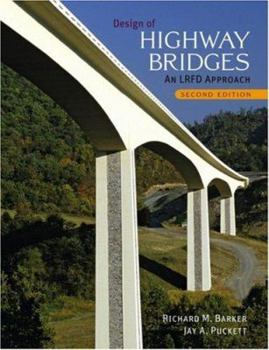
Design of Highways: An LRFD Approach

Select Format
Select Condition 
Book Overview
The up-to-date guide to applying theory and specifications to real-world highway bridge design Design of Highway Bridges, Second Edition offers detailed coverage of engineering basics for the design of short- and medium-span bridges. Based on the American Association of State Highway and Transportation Officials (AASHTO) LRFD Bridge Design Specifications, it is an excellent engineering resource. This updated edition features: * Expanded coverage of structural analysis, including axle and lane loads, along with new numerical analytic methods and approaches * Dozens of worked problems, primarily in Customary U.S. units, that allow techniques to be applied to real-world problems and design specifications * Revised AASHTO steel bridge design guidelines that reflect the simplified approach for plate girder bridges * The latest information on concrete bridges, including new minimum reinforcement requirements, and unbonded tendon stress at ultimate and losses for prestressed concrete girders * Information on key bridge types, selection principles, and aesthetic issues * Problems and selected references for further study * And more From gaining quick familiarity with the AASHTO LRFD specifications to seeking broader guidance on highway bridge design--this is the one-stop, ready reference that puts information at your fingertips.
Format:Hardcover
Language:English
ISBN:0471697583
ISBN13:9780471697589
Release Date:November 2006
Publisher:WILEY
Length:1009 Pages
Weight:0.75 lbs.
Dimensions:9.5" x 2.3" x 7.9"
Related Subjects
Arts, Music & Photography Civil Engineering Engineering Science & Math Technology TextbooksCustomer Reviews
5 ratings
Great book... If only it were in English units
Published by Thriftbooks.com User , 20 years ago
I am a bridge designer and in the final semester of my Masters degree. I recently purchased this book based on the recommendation of my former mentor. It is a quality book with good insite. My only complaint, and it is a big one, is that the examples are written in SI units. For applications in the US, this makes it very difficult to reference for quick design issues. Other than that, it's a quality book.
Buy This Book For LRFD Bridge Design
Published by Thriftbooks.com User , 21 years ago
I am a bridge designer with three years of design experience. I purchased this textbook for Dr. Barker's (author's) bridge design graduate course in college. This textbook, unlike so many others on the subject of bridge design, delves into the real nuts-and-bolts calculations of structural engineering. The most in-depth sections are loads, analysis, steel bridges, and concrete bridges. The two examples in the steel and concrete sections are thorough treatments. No subject is simply glossed over in this book. This entire text seems to have been written with the goal of answering common questions from both designers and students. From why various code requirements came to be, to exactly the meaning of obscure variables, most everything in the 1st to 2nd Ed. of the LRFD code was addressed. My only complaint about the text is that there are several mistakes in the calculations (particularly in the lengthly examples). However, most of these appear to have been corrected in subsequent printings. This book is a great desk reference for bridge designers. I cannot specifically recommend it as a study guide for the PE/SE, since those exams do not use the AASHTO LRFD specifications yet. However, for designing by the AASHTO LRFD, this book can be considered the commentary that space did not allow. As a side note, the hardback book is a nicely bound edition. The sketches, tables, and diagrams are all clear, as well as the notations used (superscripts, subscripts, Greek, etc.).
Almost a Necessity
Published by Thriftbooks.com User , 22 years ago
As a Bridge Engineer trying to figure out the new LRFD Code, I found this book to be a necessity. It is comprehensive in applying the code to actual designs. The design examples are thorough, and the logic can be followed. In all, I would recommend this book to anyone trying to learn all the provisions of the new LRFD Code.
An excellant text on bridge engineering using LRFD.
Published by Thriftbooks.com User , 27 years ago
Our office found this to be the best, and most comprehensive reference on the new LRFD Specification available. The design examples set this book apart from other references. They are as complete as any we have found. While our interest sprang from our need to learn the LRFD specification, we found that the book is a valuable tool for bridge engineering in general. Most of the designers in our office at KDOT and many of the consulting firms who work with us have a copy of this book.
Guide to new LRFD bridge design for beginner and sceptics.
Published by Thriftbooks.com User , 27 years ago
This book offers the bridge engineer a complete guide to the new LRFD specs in metric units. It is a great tool for both the new engineer, or the skeptical veteran, leery of LRFD. It offers a brief US bridge history in its introduction, and discusses aesthetics in the beginning: where it belongs. Next the development of LRFD and its advantages over ASD is discussed and should be read (and reread) carefully by the skeptics (excellent chapter). Influence lines follow, then system design, and finally concrete and steel bridge design and examples. This book is well suited to supplement the ASSHTO code or stand alone. Also, it is truly metric, no soft conversion at all. The book is quite long, however; it does command your undivided attention if it to be learned from. I highly recommend this book.
Copyright © 2026 Thriftbooks.com
Terms of Use | Privacy Policy | Do Not Sell/Share My Personal Information | Cookie Policy | Cookie Preferences | Accessibility Statement
ThriftBooks ® and the ThriftBooks ® logo are registered trademarks of Thrift Books Global, LLC
ThriftBooks ® and the ThriftBooks ® logo are registered trademarks of Thrift Books Global, LLC
