


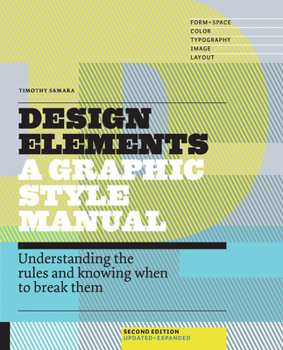
Design Elements, 2nd Edition: Understanding the Rules and Knowing When to Break Them - Updated and Expanded

Select Format
Select Condition 
Book Overview
This updated version of Rockport's bestselling Design Elements offers expanded and updated content in a new, cleaner format for easier navigation. Author Timothy Samara has added more than 50 new diagrams and more than 100 new images of real-world projects with an increased emphasis on web and environmental design projects. The "20 Rules for Good Design" has been revisited and expanded to 25 Rules. The book covers all the design fundamentals from working with grids, color application, typography, imagery to finally how to put it all together. Expansion and new material includes: -Composition/layout, visual hierarchy -Form and composition in relation to concepts and meaning -Color psychology and narrative-Color coding-Reference palettes for time periods, cultures, and businesses -Special color and printing techniques -Combining type styles, editorial text setting issues, plus-Web-related type style and hierarchy issues -Strategies for using photography; design drawing; medium and meaning; pictorial and non-pictorial -image-making options; semiotics, symbolic and metaphorical image use; type as image-Making type and imagery work better together -Finding flexibility in design systems -The design process, from creative concept development and practical work-flow standpoints... -Plus a complete project case study with major decision-moments keyed to respective sections Being a creative designer is often about coming up with unique design solutions. Unfortunately, when the basic rules of design are ignored in an effort to be distinctive, design becomes useless. In language, a departure from the rules is only appreciated as great literature if recognition of the rules underlies the text. Graphic design is a "visual language," and brilliance is recognized in designers whose work seems to break all the rules, yet communicates its messages clearly.This book is a fun and accessible handbook that presents the fundamentals of design in lists, tips, brief text, and examples. Chapters include Graphic Design: What It Is; What Are They and What Do They Do?; 25 Basic Rules of Good Design; Form and Space-The Basics; Color Fundamentals; Choosing and Using Type; The World of Imagery; Putting it All Together? Essential Layout Concepts; The Right Design Choices: 20 Reminders for Working Designers; and Breaking the Rules: When and Why to Challenge all the Rules of this Book.
Format:Paperback
Language:English
ISBN:1592539270
ISBN13:9781592539277
Release Date:May 2014
Publisher:Rockport Publishers
Length:320 Pages
Weight:2.22 lbs.
Dimensions:1.0" x 7.9" x 9.9"
Customer Reviews
4 ratings
Good introduction to GD
Published by Thriftbooks.com User , 18 years ago
Good introductory book on design. Since I've never had any sort of training in Graphic design, these concepts were really useful. Not done reading yet but so far it's been a good read.
A Visual Treat
Published by Thriftbooks.com User , 19 years ago
From the design elements of a unique placement of page numbers in the margin to very colorful representations of design elements, this book is well-worth the price. Far to often, other books attempt to explain color rendering and shape meanings without investing in professional demonstrations of the concepts. The mechanics of type, the texture of form and space, and composition strategies are well presented. A veteran graphics designer will find this book a refreshing creativity stimulant, and the new designer will find this book a genesis of ideas. I reach for this book whenever I need some brain/eye design candy. Ok, the book was not perfect. My technical communication background is the source of my quibble with the author's choice to use a light gray type in the body text against a white page. When the reader struggles with the difficulty of the read, there is a reduction in the transfer of information. It is as if to say, look only at the color because all the information is in the graphics - yet there was good information presented in the body text.
Next best thing to going to design school
Published by Thriftbooks.com User , 19 years ago
As a graphic designer with little academic preparation in the field (my college major was in psychology, supplemented by a handful of college-level art classes and several continuing education classes in Adobe software & printing technologies), I rely heavily on books for my continued growth and education. Over the past few years, I've amassed a rather large library of graphic design books. The vast majority of my collection falls into one of two categories - either "technical" (dealing with software & printing techniques) or "eye candy" (fun to look at and good for inspiring a new idea now and then, but not suited to actually improving my design skills). Timothy Samara's books are one of the few exceptions. I actually *read* his books and learn a great deal about design from them. Design Elements is the best primer on graphic design I've encountered. It starts out with 20 rules for good design, while readily admitting that rules are meant to be broken, once you fully understand them and can break them *deliberately*. It goes on to cover the topics of form & space, color, typography, images, and layout. Finished examples are combined with simple thumbnail "studies" that illustrate the concepts quite well and provide you a springboard for playing around on your own. The textual portions are concise and well-written. I heartily recommend this book for anyone seeking a serious, concise overview of all the major elements of graphic design - whether you're a student or a seasoned professional looking for a good reference book/refresher. Yes, there are books out there that cover each of these topics in much greater depth. But for what this book attempts to do, it does amazingly well.
Straight-forward and informative
Published by Thriftbooks.com User , 19 years ago
I have found this book very informative and it is written in a very straight-forward manner. Tim Samara highlights the important "rules" of graphic design, gives many examples to illustrate them, and, like the title says, helps you know when to break them. I highly recommend this book to every beginning design student.
Copyright © 2026 Thriftbooks.com
Terms of Use | Privacy Policy | Do Not Sell/Share My Personal Information | Cookie Notice | Cookie Preferences | Accessibility Statement
ThriftBooks ® and the ThriftBooks ® logo are registered trademarks of Thrift Books Global, LLC
ThriftBooks ® and the ThriftBooks ® logo are registered trademarks of Thrift Books Global, LLC
