


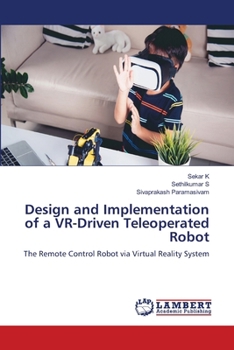
Design and Implementation of a VR-Driven Teleoperated Robot
No Customer Reviews

This book give details the evolution and technical implementation of Virtual Reality (VR) systems, specifically proposing a sophisticated architecture for the remote teleoperation of robotic vehicles through an immersive interface. Originating from Jaron Lanier's 1989 coining of the term and early military simulations by NASA, VR has evolved from cumbersome head-mounted displays (HMDs)-which often caused physical discomfort-to advanced environments like the Cave Automatic Virtual Environment (CAVE) and Binocular Omni-Orientation Monitor (BOOM). The core of the document focuses on bridging the gap in human-machine interaction (HMI) by utilizing VR to overcome the latency and bandwidth limitations inherent in standard internet-based remote control. The proposed system integrates a VR sensing unit with an Arduino microcontroller and Zigbee wireless modules to facilitate seamless communication between a human operator and a robotic vehicle. A significant portion of the technical analysis is dedicated to the hardware infrastructure, outlining the necessity of a stable power supply involving step-down transformers, bridge rectifiers for AC-to-DC conversion, and specialized voltage.
Format:Paperback
Language:English
ISBN:6209313256
ISBN13:9786209313257
Release Date:April 2026
Publisher:LAP Lambert Academic Publishing
Length:76 Pages
Weight:0.25 lbs.
Dimensions:0.2" x 6.0" x 9.0"
Customer Reviews
0 rating
Copyright © 2026 Thriftbooks.com
Terms of Use | Privacy Policy | Do Not Sell/Share My Personal Information | Cookie Policy | Cookie Preferences | Accessibility Statement
ThriftBooks ® and the ThriftBooks ® logo are registered trademarks of Thrift Books Global, LLC
ThriftBooks ® and the ThriftBooks ® logo are registered trademarks of Thrift Books Global, LLC
