


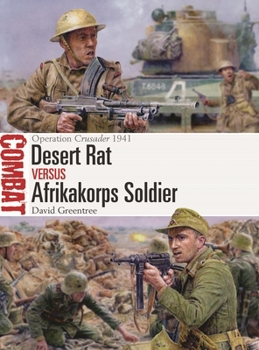
Desert Rat Vs Afrikakorps Soldier: Operation Crusader 1941
No Customer Reviews

Fully illustrated, this study assesses the importance of British and German infantry formations to the armies fighting in Operation Crusader during late 1941.
During the Desert War (1940-43), both sides viewed armour as the decisive arm because the North African terrain did not hinder its manoeuvrability. Having defeated the Italians in 1940, the British believed their infantry did not need to co-operate with tanks, enemy tanks did not need to be targeted offensively by anti-tank guns, and tanks and artillery could be dispersed. When Rommel's Deutsches Afrikakorps arrived, however, the British were rudely awakened. If infantry units lost armour support, they risked suffering crippling losses from enemy tanks. The British tended to keep their tank units close to infantry to counter German armour, meaning they were not available to the same extent as German armour to exploit battlefield successes. In this book, David Greentree investigates the effectiveness of the two sides' motorized infantry during Operation Crusader, the Allied bid to relieve the besieged port of Tobruk in late 1941. He focuses on three moments in the fighting: the British attack on 21 November; the German counter-attack on 22 November; and the struggle for Belhamed on 1-2 December. Featuring specially commissioned artwork and mapping and carefully chosen archive photographs, this is the story of the two sides' infantry at war in late 1941.Format:Paperback
Language:English
ISBN:147287191X
ISBN13:9781472871916
Release Date:February 2027
Publisher:Osprey Publishing (UK)
Length:80 Pages
Weight:1.00 lbs.
Dimensions:1.0" x 7.2" x 9.8"
Related Subjects
HistoryCustomer Reviews
0 rating
Copyright © 2026 Thriftbooks.com
Terms of Use | Privacy Policy | Do Not Sell/Share My Personal Information | Cookie Policy | Cookie Preferences | Accessibility Statement
ThriftBooks ® and the ThriftBooks ® logo are registered trademarks of Thrift Books Global, LLC
ThriftBooks ® and the ThriftBooks ® logo are registered trademarks of Thrift Books Global, LLC
