


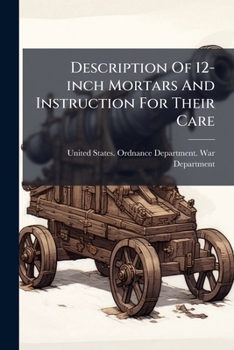
Description Of 12-inch Mortars And Instruction For Their Care

Select Format
Select Condition 
Book Overview
"Description Of 12-inch Mortars And Instruction For Their Care" offers a detailed examination of the design, operation, and maintenance of 12-inch mortars, a critical component of military artillery during the period. Originally published by the United States Ordnance Department and War Department, this manual provides essential guidance for military personnel responsible for the upkeep and effective deployment of these powerful weapons.
The book includes technical specifications, diagrams, and practical instructions intended to ensure the longevity and reliability of the mortars under diverse field conditions. It is an invaluable resource for understanding the technological and logistical aspects of military engineering and artillery practices of the era, offering insights into the strategic importance of heavy ordnance in military operations.
This historical document preserves vital knowledge of military technology and serves as a testament to the engineering expertise required to operate and maintain such complex systems.
This work has been selected by scholars as being culturally important, and is part of the knowledge base of civilization as we know it. This work was reproduced from the original artifact, and remains as true to the original work as possible. Therefore, you will see the original copyright references, library stamps (as most of these works have been housed in our most important libraries around the world), and other notations in the work.
This work is in the public domain in the United States of America, and possibly other nations. Within the United States, you may freely copy and distribute this work, as no entity (individual or corporate) has a copyright on the body of the work.
As a reproduction of a historical artifact, this work may contain missing or blurred pages, poor pictures, errant marks, etc. Scholars believe, and we concur, that this work is important enough to be preserved, reproduced, and made generally available to the public. We appreciate your support of the preservation process, and thank you for being an important part of keeping this knowledge alive and relevant.
Customer Reviews
ThriftBooks ® and the ThriftBooks ® logo are registered trademarks of Thrift Books Global, LLC
