


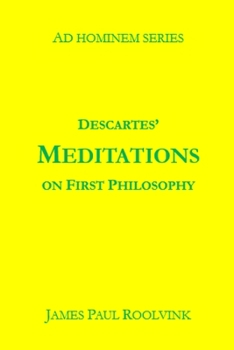
Descartes' Meditations: on First philosophy
No Customer Reviews

In 1641, Descartes' (1596-1650) 'Meditations' were published. Descartes regarded this publication as a victory over Aristotelian thought and the beginning of scientific thought, which regards mechanical causality as the sole form of causality. In the 'Meditations', science - physics in the broadest sense - is grounded in first philosophy, which concerns self-consciousness. The certain, firm foundation of physics, that which underlies physics, is called metaphysics. Objectivity is therefore intrinsically interwoven with self-consciousness. Kant would later define this idea as 'objectivity for me'-that is, how something absolute in itself is objectively present to me as a subject. Cultural anthropology arose from the further elaboration of this insight: there are multiple kinds of objectivity. This does not, therefore, lead to a subjectivist relativism in which nothing is true. There are multiple objective truths 'caught as fish' in the net of intersubjectivity in which the subjects could be seen as the noods of the net. What many fail to realise, however, is that the first philosophy of self-consciousness is itself completed in an awareness of God, the subject of theology. Awareness of God, initially in the form of the non-∞ idea of the ∞, is the condition of possibility for self-consciousness and thus for the first philosophy, metaphysics and the physical sciences. This book contains a word-for-word explanation of the 'Meditations' and demonstrates how self-consciousness arises. It demonstrates how, in the emergence of self-consciousness-without realising it at the time-Descartes draws upon Aristotelian final causality, which he was so keen to abolish. It shows that Descartes managed to gather all the ingredients needed to solve the mind-body problem and actually came very close to solving it. We also discover a new kind of proof of God's existence. Above all, this book demonstrates that Descartes was an immensely subtle thinker. He has been maligned because people (such as Husserl (1859-1938) and Heidegger (1889-1976)) never truly understood him. With this book, the spirit of Descartes will be able to shine. This book and the text above is translated by the translation machine DeepL.
Format:Paperback
Language:English
ISBN:B0H9LZBZ1N
ISBN13:9798188143084
Release Date:July 2026
Publisher:Independently Published
Length:372 Pages
Weight:0.99 lbs.
Dimensions:0.9" x 6.0" x 9.0"
Related Subjects
PhilosophyCustomer Reviews
0 rating
Copyright © 2026 Thriftbooks.com
Terms of Use | Privacy Policy | Do Not Sell/Share My Personal Information | Cookie Policy | Cookie Preferences | Accessibility Statement
ThriftBooks ® and the ThriftBooks ® logo are registered trademarks of Thrift Books Global, LLC
ThriftBooks ® and the ThriftBooks ® logo are registered trademarks of Thrift Books Global, LLC
