


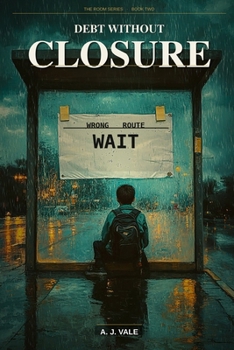
Dept Without Closure

By the time you reach this book, the first room has survived its discovery.
The city tried to contain it - called it a local truth designation, the institutional equivalent of saying we heard you, which is not the same as we changed. And while the city was finding language for what Elena Kanda had built, the room kept spreading. Into bus routes. Into hospital corridors. Into every place the city's habit of moving children from stable places into prepared ones produced one more adult who had to stop and say: not like this.
Not that way becomes small change. A route becomes just. A wrongness becomes scale. The adult answers magnitude. The child asked direction.
Debt Without Closure follows welfare officer Elena Kanda across fifty-five chapters as a city facing its own record for the first time tries to decide how much of what it owes it can pay in speech.
The answer is: less than it thinks. More than it wants to admit.
The governing laws:
The record is longer than the forms.
A fake room is any room where the adults keep the route and only soften the waiting.
The room is not a bridge. It is the correction of the road that required one.
For readers of Kazuo Ishiguro, Richard Powers, and Rachel Cusk.
A. J. Vale is a welfare and education professional with direct institutional experience in the systems this series describes. The Room Series is a debut.
The Room Series - complete trilogy:
Book 1: The First Room
Book 2: Debt Without Closure
Book 3: The Last Room
Customer Reviews
ThriftBooks ® and the ThriftBooks ® logo are registered trademarks of Thrift Books Global, LLC
