


Deposition of advanced phosphor coatings by flame spray pyrolysis
No Customer Reviews

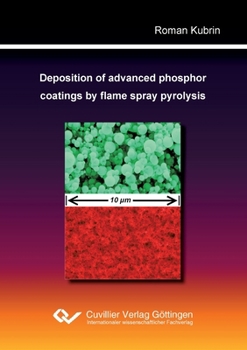
This thesis is devoted to a study of flame aerosol deposition (FAD) of advanced phosphor coatings. FAD combines synthesis of phosphor particles by flame spray pyrolysis with their deposition onto a substrate in a single processing step. Y2O3: Eu phosphor was chosen as the main test material. The mean particle size of the phosphor powder produced by droplet-to-particle conversion (DPC) of aqueous solutions of rare earth nitrates could be varied in the range 180 - 500 nm. It was found that the screens deposited from concentrated precursor solutions ( 0.5 m) achieved the brightness of the standard screens made of commercial phosphor powder ( 3.5 m). At the same time, the coating density corresponding to the maximum light emission in the transmission mode for excitation at 254 nm could be substantially reduced (0.5 vs. 2.0 mg/cm2). In the range of vacuum UV, performance of the phosphor was strongly influenced by the roughness of the particle surface. It was demonstrated that smooth Y2O3: Eu phosphor particles could be synthesized in the premixed propane/air flames by adding polymerizable organic components to the precursor solution. Alternatively, phosphor particles with improved surface morphology could be obtained by substitution of nitrate salts in the precursor solution with Y2O3: Eu nanoparticles. As opposed to Y2O3: Eu, particles of amorphous Y3Al5O12: Tb phosphor prepared by the standard DPC-FAD had nearly perfect morphology. It could be suggested that crystallization of the phosphor host during the residence time of particles in the flame is responsible for the roughness of their surface. Screens of Y2O3: Eu nanophosphor ( = 24 nm) were deposited by chemical vapor deposition (CVC-)FAD from the precursor solution prepared by dissolving rare earth nitrates in ethanol and 2-ethylhexanoic acid. The optimal screen density for excitation at 254 nm was 1.2 mg/cm2; the maximum transmission-mode luminescence intensity reached approximately one third of that of the comm
Format:Paperback
Language:English
ISBN:3954040190
ISBN13:9783954040193
Release Date:February 2012
Publisher:Cuvillier
Length:196 Pages
Weight:0.53 lbs.
Dimensions:0.4" x 5.8" x 8.3"
Customer Reviews
0 rating
Copyright © 2026 Thriftbooks.com
Terms of Use | Privacy Policy | Do Not Sell/Share My Personal Information | Cookie Policy | Cookie Preferences | Accessibility Statement
ThriftBooks ® and the ThriftBooks ® logo are registered trademarks of Thrift Books Global, LLC
ThriftBooks ® and the ThriftBooks ® logo are registered trademarks of Thrift Books Global, LLC
