


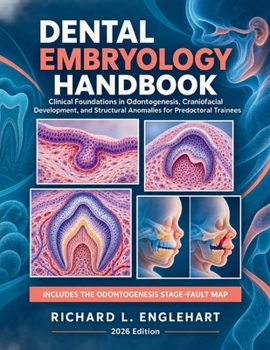
Dental Embryology Handbook 2026: Clinical Foundations in Odontogenesis, Craniofacial Development, and Structural Anomalies for Predoctoral Trainees

The Developmental Logic Behind Every Dental Anomaly a Clinician Will Recognize
Dental Embryology Handbook 2026 traces the orofacial complex from neural crest migration through tooth initiation, crown and root morphogenesis, eruption, and occlusal development, then turns that foundation directly toward the number, structural, positional, and syndromic disturbances a predoctoral trainee is expected to recognize. Written for dental, dental hygiene, and allied health trainees preparing for the INBDE.
Each developmental stage is paired with the clinical finding that results when it fails, so a presentation can be read back to its embryologic origin rather than memorized in isolation.
Inside, readers gain:
- The complete stage-by-stage sequence of odontogenesis, from dental lamina segmentation through periodontal formation, framing every anomaly within its correct developmental window.
- Neural crest and pharyngeal arch embryology underlying craniofacial syndromes including Treacher Collins syndrome and 22q11.2 deletion syndrome, explained by mechanism rather than checklist.
- Gene-to-phenotype correlations for hypodontia (PAX9, MSX1), amelogenesis imperfecta (AMELX, ENAM), and dentinogenesis imperfecta (DSPP) informing diagnosis and family counseling.
- Differential diagnosis of look-alike presentations, dens invaginatus versus evaginatus, ankylosis versus primary failure of eruption, distinguished by exact clinical sign.
- The Odontogenesis Stage-Fault Map, a dual-indexed reference cross-referencing every disturbance covered by developmental timeline and by clinical finding for rapid review.
- Eruption, shedding, occlusal development, and temporomandibular joint physiology carrying a formed dentition into function, plus a closing chapter on emerging genetic diagnostics.
Build the diagnostic reasoning this specialty depends on, starting with the developmental sequence itself.
Customer Reviews
ThriftBooks ® and the ThriftBooks ® logo are registered trademarks of Thrift Books Global, LLC
