


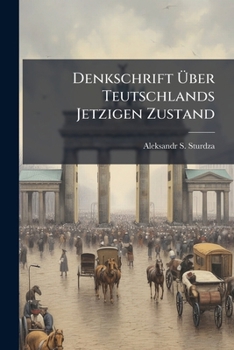
Denkschrift Über Teutschlands Jetzigen Zustand

"Denkschrift ber Teutschlands Jetzigen Zustand" (Memorandum on Germany's Current State) offers a significant perspective on the political and social conditions of Germany in the early 19th century. Penned by Aleksandr S. Sturdza, this historical document provides invaluable insights into the complex dynamics shaping Germany during a pivotal era of transformation and upheaval. This work explores the multifaceted challenges and opportunities confronting the German states as they navigated the aftermath of the Napoleonic Wars and the rise of nationalist sentiments.
Sturdza's analysis delves into the intricate web of political alliances, economic factors, and cultural currents that influenced Germany's trajectory. Readers gain a deeper understanding of the key issues that defined the period, including the quest for national unity, the struggle between conservative and liberal forces, and the impact of industrialization on German society. This memorandum serves as a crucial resource for historians and anyone interested in understanding the roots of modern Germany.
This work has been selected by scholars as being culturally important, and is part of the knowledge base of civilization as we know it. This work was reproduced from the original artifact, and remains as true to the original work as possible. Therefore, you will see the original copyright references, library stamps (as most of these works have been housed in our most important libraries around the world), and other notations in the work.
This work is in the public domain in the United States of America, and possibly other nations. Within the United States, you may freely copy and distribute this work, as no entity (individual or corporate) has a copyright on the body of the work.
As a reproduction of a historical artifact, this work may contain missing or blurred pages, poor pictures, errant marks, etc. Scholars believe, and we concur, that this work is important enough to be preserved, reproduced, and made generally available to the public. We appreciate your support of the preservation process, and thank you for being an important part of keeping this knowledge alive and relevant.
Customer Reviews
ThriftBooks® and the ThriftBooks® logo are registered trademarks of Thrift Books Global, LLC
