


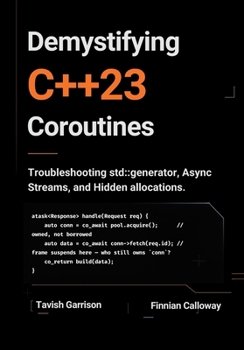
Demystifying C++23 Coroutines: Troubleshooting std::generator, Async Streams, and Hidden Allocations. (The C++ Field Guide Series)
No Customer Reviews

A coroutine that passed every test can still fail in production, and the crash will point at a resume function that has nothing to do with where the bug actually is.
Most engineers treat a clean compile and a passing test suite as proof their coroutine code is correct. It rarely is. A reference captured before a suspend point doesn't dangle in a debugger stepping through synchronously, it dangles under real production timing, when the object it points to has already been reclaimed by the time the coroutine resumes. A frame that should elide its heap allocation silently stops eliding it the moment an unrelated refactor changes how the coroutine is called. An unhandled_exception() copied from a tutorial either swallows every error your code throws or takes down the entire process on the first one, and nothing about the syntax warns you which.
Demystifying C++23 Coroutines is not an introduction to co_await or a tour of the standard library's async types. It is a strictly technical, mechanism first field guide for backend, infrastructure, and systems engineers who already write coroutine code and need to diagnose, not guess at, why their std:: generator hangs, their async stream deadlocks, or their frame allocates when it shouldn't.
Through precise compiler transform reasoning, production grade code, and real diagnostic technique, you will learn to confirm what your coroutine actually does at every suspend point instead of what the syntax implies it does, and to catch a lifetime or allocation bug before it ships instead of after a production incident finds it.
Inside the Book, You Will Diagnose and Fix:
Dangling References Across Suspension: Identify exactly which captured references and pointers survive a co_await and which don't, and convert borrowed access into owned state before it becomes a use after free under real load.
Hidden Heap Allocations: Read compiler output to confirm whether a coroutine frame actually elided its allocation, instead of assuming it did because the call site looks simple.
Deadlocks With No Lock in Sight: Trace circular awaits and executor mismatches across a call graph, and catch the specific pattern where a blocking wait and a coroutine's resume depend on the same starved thread.
Swallowed and Fatal Exceptions: Audit every promise type's unhandled_exception() for silent discards or unconditional terminates, and confirm every result-retrieval path actually checks for a captured error.
Streams That Hang or Stall Under Real Latency: Diagnose the difference between a sequential wait that serializes on your slowest source and a genuinely concurrent wait, before production traffic exposes the gap your test fixtures never could.
Backpressure That Was Never Actually Coupled: Recognize when a producer and consumer are only pretending to be paced by each other, and build a bounded channel that actually forces the coupling instead of buffering the mismatch out of sight.
Stop trusting a passing test suite or a clean compile as proof your coroutine code does what its syntax implies. Whether you're auditing an inherited async codebase or writing new coroutine types from scratch, this book gives you the exact reasoning, code, and diagnostic flow to know the difference between code that compiles and code that's actually correct under production timing.
Who this book is for: senior C++ engineers, backend and infrastructure developers, and systems engineers who already write coroutine based or asynchronous C++ and need to move from "it compiled and passed tests" to actually diagnosing and verifying lifetime, allocation, and concurrency correctness. It assumes working knowledge of modern C++. It is not an introduction to coroutines for beginners.
Scroll up and click "Buy Now" to diagnose your coroutine bugs before production finds them for you.
Most engineers treat a clean compile and a passing test suite as proof their coroutine code is correct. It rarely is. A reference captured before a suspend point doesn't dangle in a debugger stepping through synchronously, it dangles under real production timing, when the object it points to has already been reclaimed by the time the coroutine resumes. A frame that should elide its heap allocation silently stops eliding it the moment an unrelated refactor changes how the coroutine is called. An unhandled_exception() copied from a tutorial either swallows every error your code throws or takes down the entire process on the first one, and nothing about the syntax warns you which.
Demystifying C++23 Coroutines is not an introduction to co_await or a tour of the standard library's async types. It is a strictly technical, mechanism first field guide for backend, infrastructure, and systems engineers who already write coroutine code and need to diagnose, not guess at, why their std:: generator hangs, their async stream deadlocks, or their frame allocates when it shouldn't.
Through precise compiler transform reasoning, production grade code, and real diagnostic technique, you will learn to confirm what your coroutine actually does at every suspend point instead of what the syntax implies it does, and to catch a lifetime or allocation bug before it ships instead of after a production incident finds it.
Inside the Book, You Will Diagnose and Fix:
Dangling References Across Suspension: Identify exactly which captured references and pointers survive a co_await and which don't, and convert borrowed access into owned state before it becomes a use after free under real load.
Hidden Heap Allocations: Read compiler output to confirm whether a coroutine frame actually elided its allocation, instead of assuming it did because the call site looks simple.
Deadlocks With No Lock in Sight: Trace circular awaits and executor mismatches across a call graph, and catch the specific pattern where a blocking wait and a coroutine's resume depend on the same starved thread.
Swallowed and Fatal Exceptions: Audit every promise type's unhandled_exception() for silent discards or unconditional terminates, and confirm every result-retrieval path actually checks for a captured error.
Streams That Hang or Stall Under Real Latency: Diagnose the difference between a sequential wait that serializes on your slowest source and a genuinely concurrent wait, before production traffic exposes the gap your test fixtures never could.
Backpressure That Was Never Actually Coupled: Recognize when a producer and consumer are only pretending to be paced by each other, and build a bounded channel that actually forces the coupling instead of buffering the mismatch out of sight.
Stop trusting a passing test suite or a clean compile as proof your coroutine code does what its syntax implies. Whether you're auditing an inherited async codebase or writing new coroutine types from scratch, this book gives you the exact reasoning, code, and diagnostic flow to know the difference between code that compiles and code that's actually correct under production timing.
Who this book is for: senior C++ engineers, backend and infrastructure developers, and systems engineers who already write coroutine based or asynchronous C++ and need to move from "it compiled and passed tests" to actually diagnosing and verifying lifetime, allocation, and concurrency correctness. It assumes working knowledge of modern C++. It is not an introduction to coroutines for beginners.
Scroll up and click "Buy Now" to diagnose your coroutine bugs before production finds them for you.
Format:Paperback
Language:English
ISBN:B0HG99PT46
ISBN13:9798194538478
Release Date:August 2026
Publisher:Independently published
Length:141 Pages
Weight:0.52 lbs.
Dimensions:9.6" x 0.3" x 6.7"
Customer Reviews
0 rating
Copyright © 2026 Thriftbooks.com
Terms of Use | Privacy Policy | Do Not Sell/Share My Personal Information | Cookie Policy | Cookie Preferences | Accessibility Statement
ThriftBooks ® and the ThriftBooks ® logo are registered trademarks of Thrift Books Global, LLC
ThriftBooks ® and the ThriftBooks ® logo are registered trademarks of Thrift Books Global, LLC
