


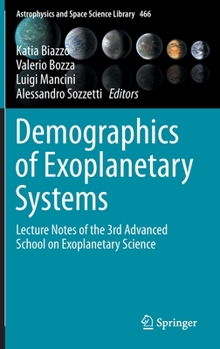
Demographics of Exoplanetary Systems: Lecture Notes of the 3rd Advanced School on Exoplanetary Science

Exoplanet formation
by Alessandro Morbidelli, Observatoire de la Cote d'Azur, Nice, France
1.1 Protoplanetary disks structure and evolution
1.1.1 Passive disks
1.1.2 Viscous alpha disks
1.1.3 Origin of viscosity
1.1.4 Disk wind dominated disks
1.2 Dust dynamics
1.2.1 Coagulation
1.2.2 Drift
1.2.3 Trapping in pressure maxima
1.2.4 Streaming instability
.3. Accretion of protoplanets
1.3.1 Runaway growth
1.3.2 Oligarchic growth
1.3.3 Pebble accretion
1.4. Type I migration
1.4.1 Lindblad torque
1.4.2 Vortensity and entropy driven corotation torques
1.4.3 Other torques
1.4.4 Migration traps
1.5. Gas accretion and Type II migration
1.5.1 Gas flow in the vicinity of a planet
1.5.2 Hydrostatic contraction of an envelope
1.5.3 Gap opening due to gas repulsion and gas accretion
1.5.4 Migration of giant planets in disks with large or small viscosities
1.6. Resonance trapping during migration
1.6.1 Structure of mean motion resonances
1.6.2 Resonant dynamics during convergent migration
1.6.3 Overstability
Chapter 2:
Exoplanet dynamics
by Sean Raymond, Laboratoire d'Astrophysique de Bordeaux
Observatoire de la Cote d'Azur, Nice, France
2.1 Observational constraints and key processes
2.1.1 Constraints from the structure of the Solar System
2.1.2 Meteorites
2.1.3 Observations of protoplanetary and debris disks
2.1.4 Observations of exoplanets
2.1.5 Planet formation models
2.1.6 Planet population synthesis modeling
2.2 Hot super-Earths
2.2.1 Constraints
2.2.2 Formation models
2.2.3 In-situ growth vs migration vs inside-out growth
2.3 Giant exoplanets
2.3.1 Formation
2.3.2 Planet-planet scattering
2.3.3 Migration
2.3.4 Origin models for hot Jupiters
2.4 The standard timeline of Solar System formation
2.4.1 The classical model of terrestrial planet formation2.4.2 The "small Mars" problem
2.4.3 The Nice model
2.5 Alternatives to the classical model
2.5.1 the Grand Tack
2.5.2 Low-mass asteroid belt
2.5.3 Early instability models
2.5.4 Dust drift and planetesimal formation
2.6 Water on Exoplanets
2.6.1 Origin of Earth's water
2.6.2 Water on rocky exoplanets
2.6.3 The diversity of processes and what they predict
Chapter 3:
Close-in Exoplanets
by Andrew W. Howard, California Institute of Technology, USA
3.1 Radial velocity and transit measurement techniques
3.1.1 RV measurements and fitting
3.1.2 Transit measurements and fitting (needed for later lectures)3.2 Mass, size, and period distributions
3.2.1 Mass distribution of giant planets
3.2.2 Mass distribution of small planets
3.2.3 Size distribution of planets
3.2.4 Orbital period / semi-major axis distributions
3.2.5 Frequency of Habitable Zone planets
3.3 Eccentricity distribution
3.3.1 Origin of eccentricities3.3.2 Measurement of eccentricities
3.3.3 Giant planet eccentricities
3.3.4 Small planet eccentricities
3.4 Orbital inclination and obliquity
3.4.1 Measurement of inclination and obliquity
3.4.2 Obliquities from Rossiter-McLaughlin and other techniques
3.4.3 Mutual inclinations
3.4.4 Dynamical origins for orbital inclinations
3.5 Planet multiplicity
3.5.1 Intra-system similarity for Kepler multi-planet systems
3.5.2 Singles vs. Multisystems
3.5.3 The Kepler 'Dichotomy'
3.6 Ultra-short perio
Customer Reviews
ThriftBooks ® and the ThriftBooks ® logo are registered trademarks of Thrift Books Global, LLC
