


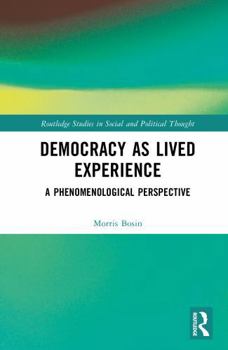
Democracy as a Lived Experience: A Phenomenological Perspective
No Customer Reviews

With this book, Morris Bosin offers a phenomenological approach to understanding democracy, not as a static system of institutions, but as a lived experience shaped by perception, participation, and meaning making. In an era marked by polarization, civic disengagement, and algorithmic influence over public discourse, this perspective provides a fresh lens for exploring how individuals and communities experience democratic life. Rather than focusing solely on laws and procedures, the book examines how citizens feel freedom, legitimacy, and collective will in everyday contexts and how alienation from these experiences fuels disaffection.
Drawing on continental philosophy, Bosin engages thinkers such as Levinas, Merleau-Ponty, Husserl, and Arendt to illuminate the existential dimensions of democratic theory. He argues that repairing democracy requires more than institutional reform; it demands attention to how democracy is lived.Through narrative, case studies, and conceptual analysis, Bosin explores how phenomenology can help bridge divides, foster dialogue, and uncover shared meaning across ideological lines. Aimed at scholars in political theory, philosophy of democracy, critical theory, and existential thought, this interdisciplinary work contributes to a growing field of inquiry. It invites readers to rethink democracy not just as a structure, but as a dynamic, felt reality, one that must be understood to be renewed.
Format:Hardcover
Language:English
ISBN:1041276648
ISBN13:9781041276647
Release Date:October 2026
Publisher:Routledge
Length:294 Pages
Customer Reviews
0 rating
Copyright © 2026 Thriftbooks.com
Terms of Use | Privacy Policy | Do Not Sell/Share My Personal Information | Cookie Notice | Cookie Preferences | Accessibility Statement
ThriftBooks ® and the ThriftBooks ® logo are registered trademarks of Thrift Books Global, LLC
ThriftBooks ® and the ThriftBooks ® logo are registered trademarks of Thrift Books Global, LLC
