


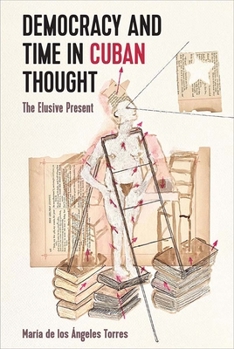
Democracy and Time in Cuban Thought: The Elusive Present

Select Format
Select Condition 
Book Overview
How the temporalities of past, future, and present have been used in Cuban political rhetoric and expressed in Cuban culture
"A very important work of political philosophy. It is a provocative read, and elegantly written."-Lisandro P rez, author of The House on G Street: A Cuban Family Saga
"An ambitious, challenging text that defies disciplinary divides. Torres makes a powerful case for Cubans' need to leave behind epic narratives of the past or utopian visions of the future to instead focus on a more deliberative, reflective, and consensual political praxis in the present."-Michael J. Bustamante, author of Cuban Memory Wars: Retrospective Politics in Revolution and Exile
"Addresses the discussion about democracy in Cuba from an original and fertile terrain where philosophy and politics come together with history and art, or more precisely, with the arts of memory and hope."-Madeline C mara Betancourt, author of Cuban Women Writers: Imagining a Matria
In this fascinating analysis of political discourse in Cuban culture, Mar a de los ngeles Torres focuses on how the concept of time has been employed by different political projects. While the past and future are often evoked in rhetoric associated with authoritarianism, Torres argues, an emphasis on human actions in the present is important for a more democratic political culture, and she searches over a century of Cuban thought for this perspective.
Delving into political texts and essays, literature, and art, Torres puts theories of temporalities in conversation with the Cuban experience. Torres closely examines the use of time and its political implications in Fidel Castro's "History Will Absolve Me" speech, the writings of Jose Mart and Che Guevara, the poetry of Eliseo Diego and the Or genes group, and paintings and performance art by Cuban exiles Nereida Garc a Ferraz, Mar a Mart nez-Ca as, and Tania Bruguera.
Recent events in Cuba have placed the search for democracy and social justice center stage, and Torres also studies the temporalities underpinning these movements, asking whether these projects are providing alternatives to overused past and future tropes. She suggests ways of thinking for today's activists, encouraging them to remember history and imagine new possibilities while cultivating space for human agency now.
Customer Reviews
ThriftBooks® and the ThriftBooks® logo are registered trademarks of Thrift Books Global, LLC
