


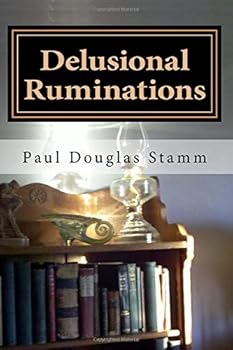
Delusional Ruminations
No Customer Reviews

A personal journal? A quirk-filled diary? A memoir of mental illness? Yes, probably all of those. What started as letters to close friends became a personal testament, a way of remembering and keeping a person who "hardly-ever-was." There is something in these rambling essays that makes them insightful, provocative, humorous, and somehow personally meaningful. The author is both a self-satisfied Cretan and a very humble soul. One aspect of this work that makes it worth reading is the closeness one feels to the author. These little stories and essays feel like tales told by a dear friend over a cup of home-brewed coffee. Reading this work is like making a new friend. The style is unconventional: both in terms of the writing and the ideas expressed. It is like paint splattered on a wall; no apparent patterns, no recognizable rules, garish, jagged, completely incongruous, and seemingly random. But very quickly the reader realizes there is some hidden direction to the disjointed paragraphs and sentences. It is an order and meaning that seems to coalesce out of the non sequiturs. As a literary device Stamm drafts jumbled, jigsaw puzzle pieces, from which, quite unexpectedly, a landscape image is formed. This work is a crude Jackson Pollock painting that upon reflection becomes Hugo Ball's Dada Manifesto. The reader experiences the transformation. On the surface, Stamm's random swirls have some of the confusion of abstract expressionism, but the core topics of his writing are very plain, very common, very much the soul of the Midwest. He takes what is commonplace, combines it with unrelated tales, and without drawing the conclusions, stimulates the reader to find the larger truths. Like a side-mounted urinal, these essays are a reflection on the illogic, alternative fact-laden, intensely capitalist society that America has become. It is not words, but paragraphs that Stamm has tossed into a hat and seemingly collaged together. Using a commixture of very everyday situations and suppressed, but every intense, emotional feelings, one can hear this author calling out "Dada." There is a fascination with language, grammar, and vocabulary that is reminiscent of the poetry of Kurt Schwitters, but the message is less Berlin and more Paris. Like Aragon, Stamm is bitterly conscience of his age and laments the passing of youth. But Delusional Ruminations is not crying over the adolescent loss of a man, but over the lost youthful vitality of a nation. The essays speak to dust on the bookshelf while calling out nationalism, colonialism, and capitalism. The essays elevate the earlier common life, while mourning a cultural and intellectual uniformity. Delusional Ruminations is clearly a personal reflection on the author's state of mind, but it is presented as an intimate conversation. The content and ideas make this a worthy read, but it is the sense of intimacy that makes this book special. The reader is allowed to look into the heart and soul of the author . . . and ultimately . . . of themselves.
Format:Paperback
Language:English
ISBN:197440546X
ISBN13:9781974405466
Release Date:August 2018
Publisher:CreateSpace Independent Publishing Platform
Length:224 Pages
Weight:0.88 lbs.
Dimensions:9.0" x 0.5" x 6.0"
Customer Reviews
0 rating
Copyright © 2026 Thriftbooks.com
Terms of Use | Privacy Policy | Do Not Sell/Share My Personal Information | Cookie Policy | Cookie Preferences | Accessibility Statement
ThriftBooks ® and the ThriftBooks ® logo are registered trademarks of Thrift Books Global, LLC
ThriftBooks ® and the ThriftBooks ® logo are registered trademarks of Thrift Books Global, LLC
