


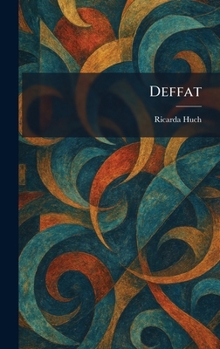
Deffat

"Deffat" is a compelling historical narrative that explores the tumultuous events of the Italian Risorgimento, focusing on the defense of the Roman Republic in 1849. Written by the distinguished author Ricarda Huch, this work delves into the revolutionary fervor that swept through Italy, centered around the charismatic leadership of Giuseppe Garibaldi and the visionary ideals of Giuseppe Mazzini.
The story captures the heroic struggle of volunteer forces as they face the daunting might of the French and Austrian armies. Huch masterfully depicts the atmosphere of 19th-century Rome, detailing the political intrigues, the bravery of the defenders, and the eventual tragic retreat of the republican troops. The narrative is not merely a military history but a profound psychological study of the men and women who risked everything for the dream of a unified and free Italy.
By blending historical precision with literary elegance, "Deffat" offers a vivid window into a pivotal moment in European history. It serves as an enduring tribute to the spirit of national liberation and the complex legacy of those who fought for the Italian cause. This work remains a vital piece of historical literature, providing deep insights into the character of Garibaldi and the birth of modern Italy.
This work has been selected by scholars as being culturally important, and is part of the knowledge base of civilization as we know it. This work was reproduced from the original artifact, and remains as true to the original work as possible. Therefore, you may see the original copyright references, library stamps (as most of these works have been housed in our most important libraries around the world), and other notations in the work.
This work is in the public domain in the United States of America, and possibly other nations. Within the United States, you may freely copy and distribute this work, as no entity (individual or corporate) has a copyright on the body of the work.
As a reproduction of a historical artifact, this work may contain missing or blurred pages, poor pictures, errant marks, etc. Scholars believe, and we concur, that this work is important enough to be preserved, reproduced, and made generally available to the public. We appreciate your support of the preservation process, and thank you for being an important part of keeping this knowledge alive and relevant.
Customer Reviews
ThriftBooks ® and the ThriftBooks ® logo are registered trademarks of Thrift Books Global, LLC
