


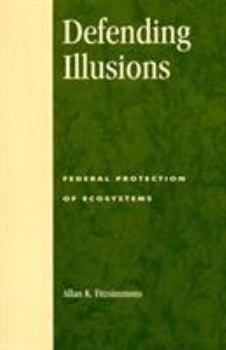
Defending Illusions: Federal Protection of Ecosystems


Select Format
Select Condition 
Book Overview
This book examines the science, philosophy, and law of ecosystem management. It shows how efforts to make federal protection of ecosystems the centerpiece of national environmental policy rest on weak science and a worldview that places concern fo the well-being of nature ahead of the well-being of people. The author goes on to suggest how we can improve our stewardship of the land.
Format:Paperback
Language:English
ISBN:0847694224
ISBN13:9780847694228
Release Date:August 1999
Publisher:Rowman & Littlefield Publishers
Length:348 Pages
Weight:0.96 lbs.
Dimensions:0.8" x 5.8" x 9.0"
Customer Reviews
1 rating
A voice of reason
Published by Thriftbooks.com User , 26 years ago
If there is any cause we are willing to support without any reservation, it is the cause for environmental preservation. Who among us is against clean air, unpolluted streams, cute bears, and fluffy birds? It is self-evident that saving the Earth for future generations is our supreme duty. Along with democracy, nature is the closest substitute for God that we worship now. Given this sanctity of the environmental cause, "Defending Illusions" is an eye-opening book. It is shocking to learn how twisted, exploited, and perverted the cause of the environment is, of course with good intentions, by "green" enthusiasts and even professional ecologists. Dr. Fitzsimmons demonstrates how hollow buzzwords are such as ecosystem health or ecosystem integrity. Yet, the outcome of these illusions is quite tangible; it is embodied in thousands of government regulations epitomized by the term "ecosystem management." As a good writer, Dr. Fitzsimmons starts with tracing the spiritual history and emotional atmosphere that made possible those illusions. Then he turns to the simplest thing any ecosystem manager must know: where to manage. To restore ecosystem health or ecosystem integrity we need to know what an ecosystem is, where one ends and another starts. The problem is that nobody can answer this basic question. Unlike organisms, which always have specialized structures (bark, skin, etc.) that separate them abruptly from the environment, ecosystems do not have well-defined boundaries other than those produced by changes in the physical environment. Anyone is free to delineate an ecosystem at will. Surely, freedom in general is admirable, but the lack of identifiable boundaries turns ecosystem management into irreproducible science. In the section "Are Ecosystems Alive?" Dr. Fitzsimmons shows that even as a conceptual entity ecosystems do not fare well. After all, Tansley introduced this term to denote a combination of Clements's superorganism and the environment. It is curious that, although the concept of superorganism is largely discredited, the ecosystem, which is so to speak a superorganism on clay footing, is still around. The confusion between an ecosystem and an organism (or superorganism) is at the core of the heated struggle for ecosystem health and integrity. These notions are possible if we equate the ecosystem with the organism. But obviously these two things are quite different. In organisms, resources are distributed and members grow according to a genetically coded blueprint transmitted from generation to generation. No centralized control exists in ecosystems. Real systems, such as organisms, that constitute the ecosystem have different, often opposite agendas. The parts of an organism die or survive together. In contrast, many components of an ecosystem thrive at the expense of others. Each biotic part of an ecosystem, an organism, is much more complex than the ecosystem itself.
Copyright © 2026 Thriftbooks.com Terms of Use
| Privacy Policy | Do Not
Sell/Share My Personal Information | Cookie Policy | Cookie Preferences | Accessibility Statement
ThriftBooks® and the ThriftBooks® logo are registered trademarks of Thrift Books Global, LLC
ThriftBooks® and the ThriftBooks® logo are registered trademarks of Thrift Books Global, LLC
