


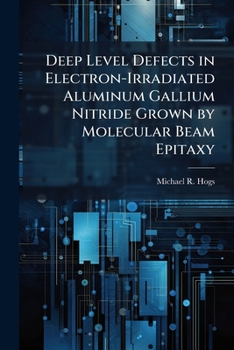
Deep Level Defects in Electron-Irradiated Aluminum Gallium Nitride Grown by Molecular Beam Epitaxy

Aluminum gallium nitride (AlGaN)-based devices are attractive candidates for integration into future Air Force communication and sensor platforms, including those that must operate in harsh radiation environments. In this study, the electrical and optical properties of 1.0 MeV electron irradiated n-AlxGa1-xN are characterized for aluminum mole fraction x = 0.0 to 0.3 using deep level transient spectroscopy (DLTS), temperature-dependent Hall, and cathodoluminescence (CL) measurements. Following irradiation of the AlGaN, it is found that four different electron traps are created, having energy levels within 0.4 eV below the conduction band edge. Three of these traps correspond to radiation-induced traps previously reported in GaN, and they are found to deepen significantly in the energy band gap with increase in aluminum mole fraction. The room temperature carrier concentration decreases following irradiation, and the carrier removal rate is found to depend foremost on the initial carrier concentration, regardless of the aluminum mole fraction. Also, following 1.0 MeV electron irradiation at a fluence of 1x1017 cm-2, the peak CL intensities of the samples are reduced, on average, by 50%. In spite of these findings, it is concluded that n-AlxGa1-xN is intrinsically more tolerant to radiation than conventional semiconductor materials such as GaAs and Si.
This work has been selected by scholars as being culturally important, and is part of the knowledge base of civilization as we know it. This work was reproduced from the original artifact, and remains as true to the original work as possible. Therefore, you will see the original copyright references, library stamps (as most of these works have been housed in our most important libraries around the world), and other notations in the work.
This work is in the public domain in the United States of America, and possibly other nations. Within the United States, you may freely copy and distribute this work, as no entity (individual or corporate) has a copyright on the body of the work.
As a reproduction of a historical artifact, this work may contain missing or blurred pages, poor pictures, errant marks, etc. Scholars believe, and we concur, that this work is important enough to be preserved, reproduced, and made generally available to the public. We appreciate your support of the preservation process, and thank you for being an important part of keeping this knowledge alive and relevant.
Customer Reviews
ThriftBooks® and the ThriftBooks® logo are registered trademarks of Thrift Books Global, LLC
