


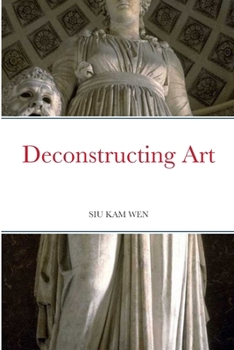
Deconstructing Art: Definite Edition
No Customer Reviews

Modern aesthetics is in as much a quagmire as modern art is. Since the nineteenth century, there has been no serious attempt at defining beauty, while the great many of theorists focus their at- tention on a concocted concept that is foreign and unnatural to say the least: the aesthetic. Art theory, on the other hand, failed utterly in its fundamental task when it handed the artist and the so-called "artworld" a carte blanche -in the form of the institu- tional theory of art- to decide by themselves what art is and is not. This study attempts to fill both niches thus left gaping. The study is the practical application of a method that we have first gleaned in On Names, Ideas, and Super Ideas. The method re- quires that we treat the idea or concept of art as a mental mish- mash that has resulted from an atypical, messy process of abstrac- tion, and recognize the fact that the meaning of the word art can- not be encompassed by a single definition. The only way to de- fine art is to "break down" this mental mishmash into "compo- nent" ideas that would have resulted from the process of abstrac- tion, had it been typical; and provide a definition for each of such "component" ideas. The work is divided into five parts. Parts I and II provide an objective definition of art. Part III provides an objective definition of beauty. Part IV provides "guidelines" for judging or appreciating any work of art. And Part V provides a rather personal interpretation of what went on in the arts during the twentieth century.
Format:Paperback
Language:English
ISBN:1300052260
ISBN13:9781300052265
Release Date:July 2025
Publisher:Lulu.com
Length:198 Pages
Weight:0.60 lbs.
Dimensions:0.4" x 6.0" x 9.0"
Related Subjects
PhilosophyCustomer Reviews
0 rating
Copyright © 2026 Thriftbooks.com
Terms of Use | Privacy Policy | Do Not Sell/Share My Personal Information | Cookie Policy | Cookie Preferences | Accessibility Statement
ThriftBooks ® and the ThriftBooks ® logo are registered trademarks of Thrift Books Global, LLC
ThriftBooks ® and the ThriftBooks ® logo are registered trademarks of Thrift Books Global, LLC
