


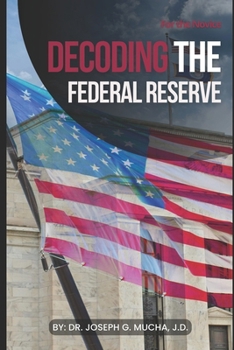
Decoding the Federal Reserve: For the Novice
No Customer Reviews

Decoding the Federal Reserve is a testament to the ongoing quest for financial stability and prosperity in an interconnected world. In the landscape of global finance, the Federal Reserve System of the United States, or the Fed, stands as a pivotal institution. Established in the early 20th century, the Fed was a response to the financial instability that plagued the U.S. economy, notably epitomized by the Panic of 1907. This period of bank runs, and stock market crashes underscored the need for a stabilizing force, leading to the creation of the Federal Reserve through the Federal Reserve Act of 1913. This transformative legislation marked a significant shift from a decentralized banking system to one anchored by a central monetary authority. The Federal Reserve's structure is unique, comprising the Board of Governors, 12 regional Federal Reserve Banks, and the Federal Open Market Committee (FOMC). The Board of Governors, based in Washington, D.C., oversees the system and guides national monetary policy, with members appointed by the President and confirmed by the Senate. The regional Federal Reserve Banks, spread across 12 districts, serve as the operational arms of the Fed, playing key roles in implementing monetary policy, supervising member banks, and providing financial services. The FOMC, which includes the Board of Governors and five regional bank presidents, is the primary body responsible for setting U.S. monetary policy.
Format:Paperback
Language:English
ISBN:B0CTT8TVL9
ISBN13:9798878194242
Release Date:February 2024
Publisher:Independently Published
Length:162 Pages
Weight:0.50 lbs.
Dimensions:0.3" x 6.0" x 9.0"
Customer Reviews
0 rating
Copyright © 2026 Thriftbooks.com Terms of Use
| Privacy Policy | Do Not
Sell/Share My Personal Information | Cookie Policy | Cookie Preferences | Accessibility Statement
ThriftBooks® and the ThriftBooks® logo are registered trademarks of Thrift Books Global, LLC
ThriftBooks® and the ThriftBooks® logo are registered trademarks of Thrift Books Global, LLC
