


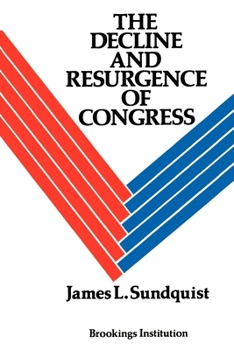
The Decline and Resurgence of Congress


Select Format
Select Condition 
Book Overview
""Solid ground for optimism as well as cause for foreboding."" So James L. Sundquist views the outcome of the struggle by the Congress in the 1970s to recapture powers and responsibilities that in preceding decades it had surrendered to a burgeoning presidency. The resurgence of the Congress began in 1973, in its historic constitutional clash with President Nixon. For half a century before that time, the Congress had acquiesced in its own decline vis- -vis the presidency, or had even initiated it, by building the presidential office as the center of leadership and coordination in the U.S. government and organizing itself not to initiate and lead but to react and follow. But the angry confrontation with President Nixon in the winter of 1972-73 galvanized the Congress to seek to regain what it considered its proper place in the constitutional scheme. Within a short period, it had created a new congressional budget process, prohibited impoundment of appropriated funds, enacted the War Powers Resolution, intensified oversight of the executive, extended the legislative veto over a wide range of executive actions, and vastly expanded its staff resources. The Decline and Resurgence of Congress, after reviewing relations between president and Congress over two centuries, traces the long series of congressional decisions that created the modern presidency and relates these to certain weaknesses that the Congress recognized in itself. It then recounts the events that marked the years of resurgence and evaluates the results. Finally, it analyzes the strengths and weaknesses of the new Congress and appraises its potential for leadership and coordination.
Format:Paperback
Language:English
ISBN:0815782233
ISBN13:9780815782230
Release Date:September 1981
Publisher:Brookings Institution Press
Length:516 Pages
Weight:1.55 lbs.
Dimensions:1.3" x 6.0" x 9.0"
Customer Reviews
2 ratings
an optimistic view of congress' potential
Published by Thriftbooks.com User , 18 years ago
This is an absolutely fascinating historical analysis of the push and pull between Congress and the Executive branch. It begins pretty much at the beginning of the American democracy and comes right up to the post-Watergate era. As the other reviewer noted, there were many significant accomplishments that limited executive power, such as the War Powers Act, but there are many other examples. Sundquist demonstrates that the blunt instrument of legislation, with all the fractiousness of its collective membership, had effectively been wielded in the past. His view is predominently positive and optimistic, that Congress can undertake meaningful initiatives, etc. I think that this perspective dates the book somewhat. While I do not know American history as well as does the author, I would argue that the recent divisiveness in the political environment of the US - with the potential exception of the pre-Civil era - points to the decline of Congress into symbolic rather than real action, that it has lost a great deal of its capacity for substantive action. Sundquist does not address this issue sufficiently, in my view. I hope that this will change, but I am not so optimistic. Nonetheless, this is a dazlingly readable book by a great scholar, written in uniquely elegant style, one of the most interesting on the Congress that I have ever read, indeed one of the best poli-sci books I know. Warmly recommended.
The title says is all
Published by Thriftbooks.com User , 22 years ago
This is a classic study of the struggle for policy leadership and, indeed, preeminence between the Congress of the United States and the President. James L. Sundquist, a highly respected student of Congress, charts the decline of Congress as the leading policymaking body in the early and middle part of the 19th century and also shows the increase in power of the President.The President, with the active participation and acquiescence of the Congress, begins to assert a broader and more decisive leadership role in terms of managing the economy. The Budget and Accounting Act of 1921, the creation of the modern Office of Management and Budget, and the Employment Act of 1946 give the President unprecedented powers in managing the economy.The President also asserts broader powers with regard to foreign policy. The war and tariff setting powers are delegated to the President. Further, the President acquires even more influence as the initiator of legislation for the consideration of the legislative branch.These trends are long term and evolve over a long period of time beginning in the early part of this century. The reach their zenith with the Presidency of Richard Nixon.Nixon so abuses the relation with the Congress and attempts to use the powers given to the President that the Congress finally moves to reassert its prerogative. By a series of legislative actions, (the War Powers Act; the Congressional Budget and Impoundment Control Act of 1974; the extensive use of the legislative veto {later declared unconstitutional}; a thoroughgoing reform of the committee system and legislative process; and an a strengthening of Congressional capacity by increasing resources available to individual members) Congress reasserts is legitimate role in the policymaking process.A very interesting story and well told. It is a very detailed book and a must read for Congressional specialists. John C. McKee
Copyright © 2026 Thriftbooks.com Terms of Use
| Privacy Policy | Do Not
Sell/Share My Personal Information | Cookie Policy | Cookie Preferences | Accessibility Statement
ThriftBooks® and the ThriftBooks® logo are registered trademarks of Thrift Books Global, LLC
ThriftBooks® and the ThriftBooks® logo are registered trademarks of Thrift Books Global, LLC
