


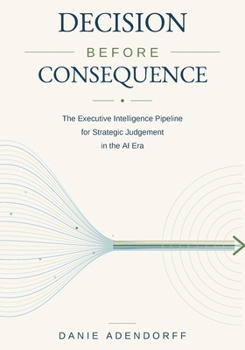
Decision Before Consequence

How do leaders make sound decisions when information is abundant, AI is accelerating, uncertainty remains, and consequences can close the available options?
Decision Before Consequence develops a practical executive architecture for turning signals and information into validated intelligence, accountable judgement, timely decision, controlled action and adaptation. Its central framework, the Executive Intelligence Pipeline, follows the sequence Signal → Validation → Interpretation → Escalation → Decision → Action → Adaptation.
The book addresses a central weakness in contemporary organisations: being information-rich does not necessarily mean being decision-ready. Dashboards, reports, risk registers, forecasts and AI-generated outputs can increase visibility while still leaving leaders strategically late. The problem is not simply access to information. It is the disciplined conversion of information into judgement and action before consequence becomes irreversible.
Across seventeen chapters, the book examines intelligence grading, uncertainty, continuous sensing, interpretive authority, strategic warning, governance, decision survivability, boundary conditions, trade-off ownership and distributed judgement. It also develops AI-era disciplines including the Jagged Frontier Governance Principle, the Production-to-Decision Gap and the Human Return Point, which identifies where accountable human authority must explicitly return before AI-supported work becomes consequence-bearing.
Practical diagnostic tools, doctrine boxes, figures, tables and case-method exercises translate the analysis into usable executive disciplines. The Decision Laboratory Method trains readers to judge before the outcome is known rather than relying on hindsight after consequence has revealed the answer.
Written for executives, boards, senior managers, risk and security professionals, resilience and continuity leaders, AI governance teams, policy practitioners and leadership educators, Decision Before Consequence is designed for readers working where uncertainty, speed, authority and consequence meet.
The book does not promise perfect foresight. It provides a disciplined framework for deciding responsibly while meaningful choice still exists.
Customer Reviews
ThriftBooks ® and the ThriftBooks ® logo are registered trademarks of Thrift Books Global, LLC
